The Secret Life of Books Hidden stories. Untold truths. Every book
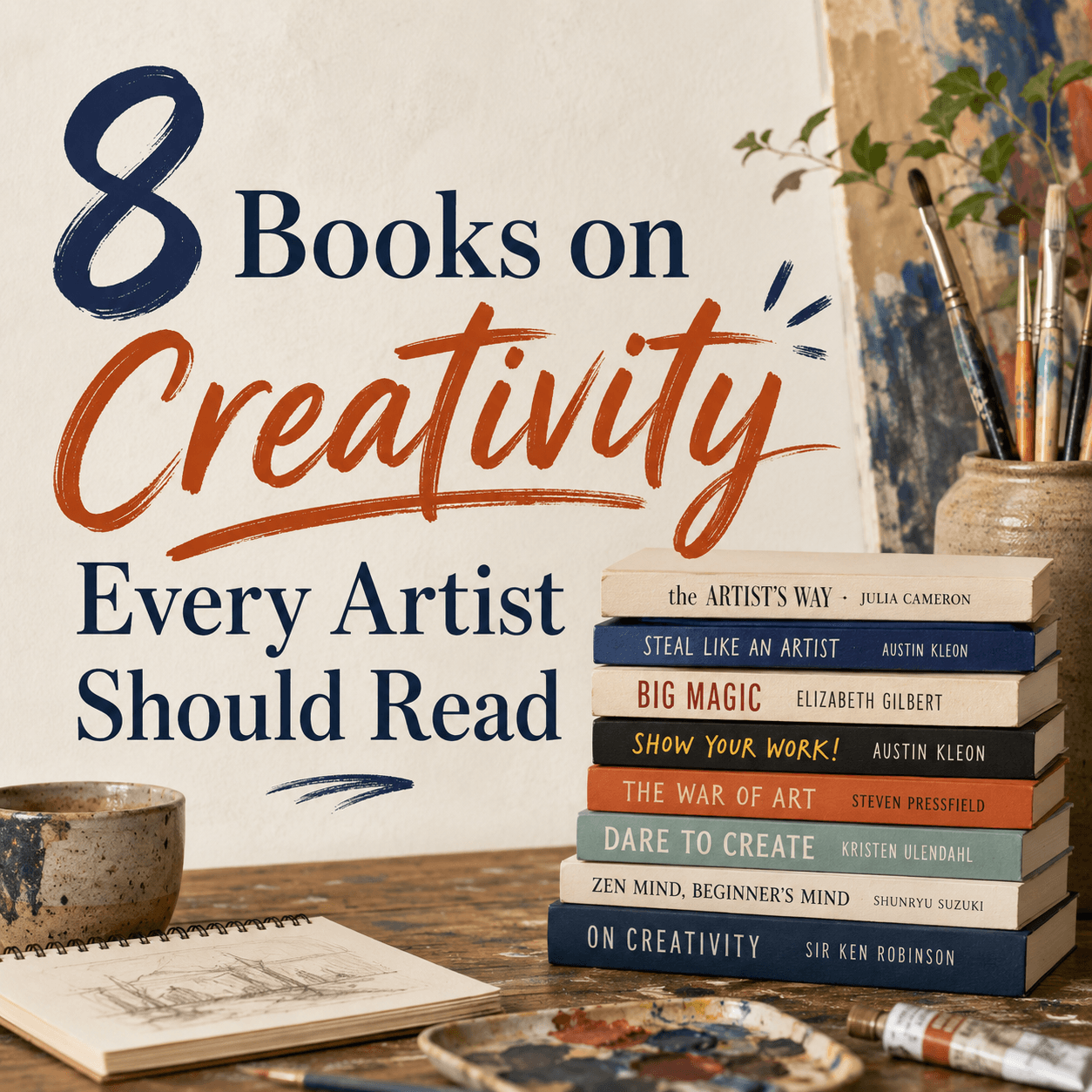
8 Books on Creativity Every Artist Should Read
A curated guide to the best books on creativity for artists — discipline, inspiration, craft, and the creative life
Books on creativity for artists are more than casual reading — they are tools for survival in a profession that demands constant output, resilience, and self-belief. Whether you are a painter staring at a blank canvas, a writer wrestling with the first sentence, or a musician searching for the next note, the battle is the same: showing up, doing the work, and trusting the process.
Over decades, some of the most insightful minds in art and literature have written about this very struggle. Their books are not theory-laden textbooks. They are lifelines — practical, philosophical, and deeply human guides to living a creative life.
Here are eight essential books on creativity for artists, presented as a curated reading list for anyone who makes things. Each offers a unique lens on the creative process, and together they form a complete education in the art of making.
1. The War of Art — Steven Pressfield
Best for: Overcoming procrastination and building creative discipline
The Core Idea
Resistance is the enemy of creativity, and the only way to beat it is to sit down and do the work. Steven Pressfield’s The War of Art has achieved cult status among writers, painters, entrepreneurs, and anyone who has ever struggled to begin. The book is built around a single, powerful concept: Resistance. Pressfield defines Resistance as the invisible force that keeps us from doing our most important work — procrastination, self-doubt, fear of judgment, perfectionism, and the endless lure of distraction.
Pressfield divides the book into three parts: Resistance, Combating Resistance, and Beyond Resistance. He introduces the concept of “turning pro” — treating your art as a profession rather than a hobby, showing up every day regardless of mood or inspiration.
“The most important thing about art is to work. Nothing else matters except sitting down every day and trying.”
Why Artists Should Read It
It is the most direct, no-excuses kick in the pants you will ever receive. If you struggle with starting, with finishing, or with taking your own work seriously, this book will realign your mindset in under 200 pages.
Key Takeaway
The opposite of fear is not courage — it is discipline. Show up, sit down, and do the work. The muse rewards action, not intention. This is one of the books on creativity for artists that belongs on every shelf.
2. Big Magic — Elizabeth Gilbert
Best for: Overcoming creative anxiety and finding joy in making
The Core Idea
Creativity is a force of wonder, and living a creative life is about curiosity, not certainty. Elizabeth Gilbert wrote Big Magic as a love letter to the creative process. Where Pressfield is the drill sergeant, Gilbert is the encouraging friend who reminds you that creativity does not have to be a torturous ordeal.
Gilbert dismantles the myth of the “tortured artist.” She argues that creativity and suffering are not bound together, and introduces the concept of ideas as living entities that seek out human collaborators — a liberating framework that removes the crushing weight of “genius” from the artist’s shoulders.
Why Artists Should Read It
It is an antidote to creative anxiety. If you have ever felt that your work is not good enough, that you have no right to call yourself an artist, or that creativity must involve suffering — this book on creativity for artists will set you free.
Key Takeaway
Done is better than good. Perfectionism is the enemy of creativity. Make things for the joy of making them, and let the rest take care of itself.
3. Steal Like an Artist — Austin Kleon
Best for: Finding your creative voice and overcoming the pressure to be original
The Core Idea
Nothing is original. All creative work builds on what came before, and that is not only okay — it is how art progresses. Kleon argues that every artist is influenced by those who came before, and the key to creativity is learning to remix, transform, and combine influences in new ways.
Kleon offers ten actionable principles: “Steal like an artist,” “Don’t wait until you know who you are to get started,” “Be boring (it’s the only way to get work done),” and “Creativity is subtraction.”
Why Artists Should Read It
It liberates you from the paralyzing pressure to be original. Your voice emerges naturally from the combination of your influences — imitation is a necessary step toward innovation.
Key Takeaway
Nothing comes from nowhere. Study your heroes, copy them closely at first, then find your own path by combining influences in ways only you can.
4. Bird by Bird — Anne Lamott
Best for: Overcoming overwhelm and learning to work in small steps
The Core Idea
Writing — and by extension, any creative work — is done one small step at a time, “bird by bird.” Lamott’s father once told her overwhelmed brother to take his school report on birds “bird by bird.” That phrase is the beating heart of this book. Creativity is overwhelming when viewed as a whole. A novel, a painting, a symphony — these are monstrous undertakings. But a page, a brushstroke, a single note — those are achievable.
Why Artists Should Read It
It is the most human and forgiving book on creativity for artists on this list. If you are drowning in the scale of your ambitions, Lamott reminds you that all big things are made of small parts — focus on the next small piece.
Key Takeaway
Take it bird by bird. The only way to finish anything is to stop worrying about the whole and focus on the next tiny, doable piece.
5. The Artist’s Way — Julia Cameron
Best for: Unblocking creativity through structured practice
The Core Idea
Creativity is a spiritual practice, and anyone can recover their creative identity by following a structured program of self-discovery. With over four million copies sold, The Artist’s Way is one of the most influential books on creativity for artists ever written. It offers a 12-week program built around two core practices:
Morning Pages: Write three pages of stream-of-consciousness text by hand every morning. This clears mental clutter that blocks creativity.
The Artist Date: Take yourself on a solo weekly outing to something that feeds your creative spirit — a museum, a nature walk, a concert.
Why Artists Should Read It
It is the most comprehensive creativity recovery program available. If you feel blocked, stuck, or disconnected from your creative self, the 12-week program offers a structured path back.
Key Takeaway
Creativity is your birthright. Blocked creativity is not a character flaw — it is a condition that can be healed through consistent practice, self-compassion, and play.
6. Show Your Work! — Austin Kleon
Best for: Building an audience and sharing your creative process
The Core Idea
Creativity does not happen in a vacuum. Sharing your process — the unfinished, imperfect, in-progress work — is as important as sharing the finished product. Kleon argues the old model of hiding away to perfect your work is broken. In the internet age, successful artists share their process openly: sketches, works-in-progress, failed attempts, and behind-the-scenes looks.
Why Artists Should Read It
In a world where talent alone is no longer enough, visibility matters. This book teaches you how to share your work without selling out, and how to build an audience that grows with you.
Key Takeaway
You do not need to be a genius to have something to share. Your process, your struggles, and your journey are valuable to someone. Share them generously.
7. The Creative Habit — Twyla Tharp
Best for: Building a sustainable daily creative practice
The Core Idea
Creativity is not a mysterious bolt of inspiration — it is a habit, built on routine, discipline, and deliberate practice. One of America’s most celebrated choreographers, Tharp approaches creativity like an athlete trains: with rituals, preparation, cross-training, and relentless repetition.
The book offers 32 concrete exercises Tharp has used throughout her career — repeatable practices for generating ideas, breaking through blocks, and staying creative over the long haul.
Why Artists Should Read It
This is the most practical book on creativity for artists on the list. If you want a real system for doing the work day after day, Tharp delivers.
Key Takeaway
Creativity is a habit. The best artists are not the most talented — they are the most consistent. Build rituals, eliminate distractions, and do the work every single day.
8. The Art of Fiction — David Lodge
Best for: Understanding narrative craft and storytelling technique
The Core Idea
Understanding the craft of storytelling is essential for any narrative artist. Lodge takes 50 concepts — from “beginning” to “ending,” covering point of view, irony, symbolism, and metafiction — and illustrates each with close readings of classic novels.
Each essay is a pleasure to read, opening up the machinery of great fiction and showing how it works.
Why Artists Should Read It
It bridges the gap between reading and making. If you want to learn from the masters — not by copying them but by understanding their techniques — Lodge is your guide.
Key Takeaway
The difference between good art and great art is often craft, not inspiration. Study the techniques of those who came before you.
Frequently Asked Questions
What is the best book on creativity for artists?
The best book on creativity for artists depends on your needs. The War of Art by Steven Pressfield is ideal for overcoming procrastination, while Big Magic by Elizabeth Gilbert is perfect for curing creative anxiety. For a structured program, The Artist’s Way is unmatched.
How can books on creativity help artists?
Books on creativity for artists provide practical techniques to overcome creative blocks, build disciplined habits, find inspiration when stuck, and develop a sustainable artistic practice that lasts a lifetime.
Are these creativity books suitable for beginners?
Yes. The Artist’s Way by Julia Cameron and Steal Like an Artist by Austin Kleon are perfect for beginners, offering accessible, immediately actionable advice without assuming prior knowledge.
Which creativity book should I read first?
Start with The War of Art if you struggle with procrastination, or The Artist’s Way if you feel creatively blocked. Big Magic is best if you need encouragement to begin.
Build Your Creative Library
These eight books on creativity for artists approach the creative life from different angles — Pressfield’s
discipline, Gilbert’s permission, Kleon’s remix culture, Lamott’s patience, Cameron’s spirituality, Tharp’s
habit-building, and Lodge’s craft analysis. Together, they form a complete education.
If you are an artist, read them all. Read them slowly. Take notes. Try the exercises. Return to them when
you are stuck. Then close the book and get back to work.
The world needs what you have to make. These books will help you make it.