The Secret Life of Books Hidden stories. Untold truths. Every book
The Strange Case of Dr. Jekyll and Mr. Hyde: The Monster Within
The London of the late nineteenth century was a city of contradictions. Gas lamps illuminated elegant streets while shadows concealed poverty, crime, and secrets. The British Empire stood at the height of its power, science was advancing at an astonishing pace, and Victorian society prided itself on morality and respectability. Yet beneath the polished surface, another reality existed—one filled with hidden desires, forbidden impulses, and private struggles.
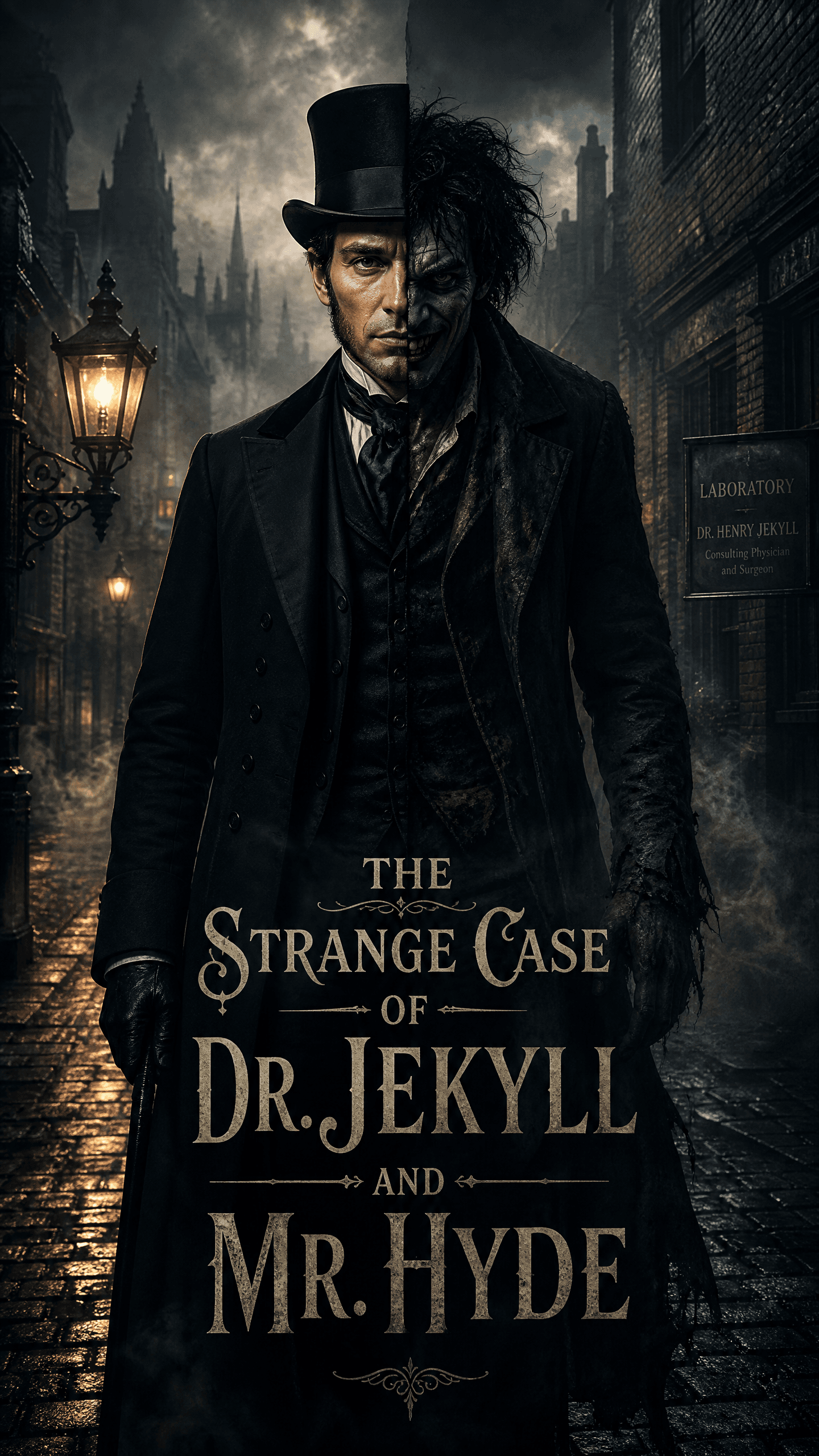
It was in this world that Robert Louis Stevenson lived and wrote. The Victorian age encouraged people to present a controlled, respectable image of themselves to society. Emotions were restrained, instincts were suppressed, and appearances mattered enormously. But Stevenson was fascinated by what existed beneath those appearances. What happened to the parts of ourselves that we hide? Could a person truly separate good from evil within the human soul?
These questions found their most haunting expression in The Strange Case of Dr. Jekyll and Mr. Hyde, a novella that would become one of the most enduring explorations of human nature ever written.
The story begins not with a scream or a murder, but with a mystery. In the fog-covered streets of London, a respected lawyer named Mr. Utterson hears disturbing stories about a strange and unpleasant man called Edward Hyde. Hyde seems to leave behind a trail of unease wherever he goes. People struggle to explain exactly what is wrong with him, yet they instinctively recoil from his presence.
One incident in particular spreads alarm. A young girl is accidentally knocked down in the street, and Hyde coldly tramples over her body without a hint of remorse. His cruelty shocks everyone who witnesses it. Yet what is even more troubling is Hyde’s connection to the respected Dr. Henry Jekyll.
Dr. Jekyll appears to be everything Hyde is not. Wealthy, educated, generous, and admired, he enjoys an excellent reputation in society. His home welcomes distinguished guests, and his accomplishments earn widespread respect. Why, then, has he left part of his fortune to such a sinister figure? Why does he seem strangely protective of him?
As Utterson investigates, the mystery deepens. Hyde appears and disappears like a shadow. Dr. Jekyll becomes increasingly withdrawn. Doors are locked. Servants whisper. Strange sounds echo from laboratories late into the night. The atmosphere grows heavier with every chapter, as though London itself is holding its breath.
What the world does not know is that Dr. Jekyll has been conducting an experiment unlike any other.
Jekyll has spent years wrestling with a truth he believes lies at the heart of every human being. He recognizes within himself two opposing forces. One strives for goodness, respectability, and kindness. The other hungers for freedom from moral restraint. Like many people, he wears a public mask while concealing desires that society would condemn.
But Jekyll dreams of something impossible. What if these two sides could be separated? What if a person could divide the noble self from the darker self?
Driven by ambition and curiosity, he creates a chemical formula that transforms him physically and psychologically. The result is Edward Hyde.
Hyde is not merely another identity. He is the embodiment of everything Jekyll has repressed. Smaller in stature yet terrifying in spirit, Hyde represents pure selfishness unleashed from conscience. Through him, Jekyll experiences a dangerous sense of liberation. No longer burdened by guilt or social expectations, he can indulge impulses he once kept hidden.
At first, the transformation feels empowering. Hyde becomes a secret escape from responsibility. Jekyll can enjoy the pleasures of freedom and then return to his respectable life without consequence.
But evil rarely remains under control.
Gradually, Hyde grows stronger. The transformations become easier. The temptation becomes harder to resist. The darkness Jekyll thought he could manage begins to dominate him.
What begins as an experiment evolves into a nightmare.
The tragedy of Dr. Jekyll lies not simply in his scientific mistake but in his misunderstanding of himself. He believes good and evil can be neatly separated, as though they are independent creatures living within the same body. Yet human nature is rarely that simple. Our virtues and flaws are intertwined. To deny one part of ourselves entirely is to misunderstand what it means to be human.
Edward Hyde becomes increasingly violent because he exists without balance. He possesses desire without restraint, freedom without responsibility, impulse without empathy.
The most shocking moment arrives when Hyde commits a brutal murder. In a sudden eruption of violence, he kills a respected member of society, shattering any illusion that he can remain hidden. From that moment forward, fear replaces excitement. Jekyll realizes he has created something he can no longer control.
The story’s horror does not come from ghosts or supernatural monsters. Its horror comes from recognition.
Who has never felt conflicting desires? Who has never struggled between what is right and what is tempting? Who has never hidden parts of themselves from the world?
Stevenson understood that the most frightening monsters are often the ones we carry within.
The philosophical heart of the novella rests on the idea of duality. Every human being contains contradictions. We are capable of generosity and selfishness, courage and fear, compassion and cruelty. Society often encourages us to present a single identity, but reality is far more complicated.
Jekyll’s tragedy emerges from his refusal to accept this complexity. Rather than integrating the different aspects of his personality, he attempts to divide them completely. In doing so, he creates an imbalance that destroys him.
The novella also explores the dangers of repression. Victorian society demanded strict self-control, yet Stevenson suggests that denying human impulses entirely can be dangerous. What happens when emotions are buried rather than understood? What happens when desires are hidden instead of confronted?
These questions extend far beyond the Victorian era.
Today, people continue to create versions of themselves for public display. Social media profiles, professional identities, and carefully curated images often conceal private struggles. Many individuals feel pressure to appear successful, confident, and morally certain even when reality is more complicated.
The world has changed dramatically since Stevenson wrote his novella, yet the tension between public identity and private self remains remarkably familiar.
Modern readers recognize themselves in Jekyll’s struggle because the conflict is universal. The challenge is not to eliminate our darker impulses but to understand them. Wisdom comes not from pretending darkness does not exist but from acknowledging it honestly.
As the story approaches its conclusion, Jekyll loses control completely. Transformations occur without warning. Hyde emerges even when Jekyll desperately wishes to remain himself. The boundaries between the two identities collapse.
In his final confession, Jekyll reveals the full truth behind the mystery. His experiment has failed. The monster he sought to control has become stronger than the man who created him.
The ending carries a profound sadness. Jekyll is neither wholly innocent nor wholly evil. He is a human being destroyed by his attempt to escape the complexity of human nature. His downfall serves as both a warning and a lament.
The final pages leave readers not with triumph but with reflection. Stevenson suggests that humanity’s greatest challenge is not conquering evil but understanding ourselves. The battle between light and darkness is not fought in distant places; it unfolds quietly within every individual heart.
More than a century after its publication, The Strange Case of Dr. Jekyll and Mr. Hyde continues to resonate because its central question remains unanswered. We still wrestle with competing desires. We still hide parts of ourselves. We still wonder where the boundary lies between who we are and who we might become.
Perhaps that is why the story endures. Beneath its mystery and horror lies a mirror held up to humanity itself. It reminds us that the line between virtue and vice is not drawn between different people but within each person.
And as we close the book and step back into our own lives, one unsettling question lingers in the shadows: if we could separate the best and worst parts of ourselves, would we truly be freer—or would we simply discover that neither can exist without the other?