The Secret Life of Books Hidden stories. Untold truths. Every book
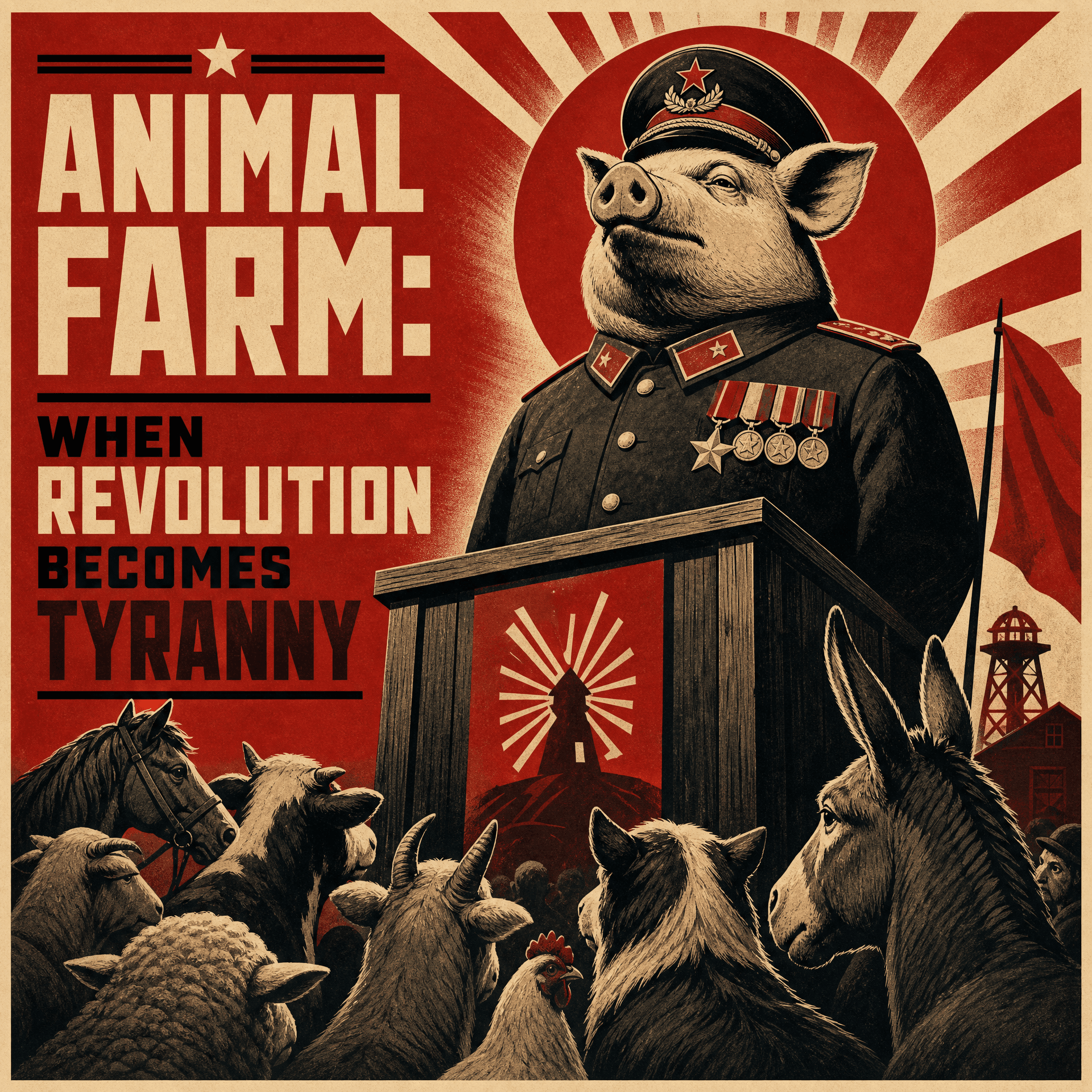
Animal Farm: When Revolution Becomes Tyranny
The first half of the twentieth century was an age of revolutions, wars, and political upheaval. Across Europe, old systems collapsed while new ideologies promised a better future. Millions of people dreamed of equality, justice, and freedom. They imagined societies where power would belong to ordinary citizens rather than kings, aristocrats, or dictators.
Yet history often revealed a painful pattern.
Many revolutions began with noble ideals but ended with new forms of oppression. The promises remained the same, but the faces in power changed.
Few writers understood this contradiction more clearly than George Orwell. Having witnessed political conflict, propaganda, and the rise of totalitarian regimes, Orwell became deeply concerned with how power could corrupt even the most idealistic movements. He believed that truth was fragile and that freedom could disappear not only through violence but through manipulation.
Out of those concerns came Animal Farm, a short novel that reads like a simple fable yet carries the weight of a profound political and human tragedy.
The story begins on Manor Farm, a place where animals labor endlessly while receiving little in return. Their owner, Mr. Jones, is careless and neglectful. The animals work hard, but the rewards of their efforts belong to someone else.
One evening, an old boar named Old Major gathers the animals together.
His speech is filled with hope and conviction. He speaks of a future where animals will govern themselves, where exploitation will end, and where equality will prevail. He paints a vision of freedom so powerful that it ignites something deep within every listener.
For the animals, it feels like the dawn of a new world.
Soon after, a rebellion erupts.
Mr. Jones is driven from the farm, and the animals seize control of their own destiny. Their victory feels exhilarating. Fields, barns, and pastures that once symbolized oppression now seem filled with possibility.
The farm is renamed Animal Farm.
For a brief moment, the dream appears real.
The animals work together. Decisions are made collectively. Hope fills the air. The future seems bright.
But revolutions are rarely tested during moments of victory.
They are tested after power is won.
Among the leaders of the new society are two pigs: Snowball and Napoleon.
Snowball is energetic, intelligent, and enthusiastic about improving life for everyone. Napoleon, quieter and more calculating, watches from the shadows. At first, their differences seem manageable.
Yet beneath the surface, a struggle is already taking shape.
As time passes, disagreements grow into rivalries. Rivalries become conflicts. Eventually, Napoleon seizes control through force, using trained dogs as instruments of intimidation.
The revolution that promised freedom begins to change.
Not suddenly.
Not all at once.
But little by little.
Rules are adjusted. History is rewritten. Dissent becomes dangerous. The principles that once united the animals start to fade.
And perhaps the most disturbing aspect of the transformation is how ordinary it seems.
The animals remember a dream of equality, yet they struggle to challenge what is happening before their eyes. They work harder than ever while receiving less and less. They hear constant promises of prosperity even as their conditions worsen.
Whenever reality contradicts the official narrative, the narrative wins.
This gradual corruption forms the emotional and philosophical heart of Animal Farm.
At the center of the story stands Napoleon, one of literature’s most chilling portraits of power. Unlike dramatic villains who openly embrace evil, Napoleon advances through patience, manipulation, and control.
He understands something dangerous.
Power does not always require force.
Often, it requires controlling information.
Through propaganda, fear, and carefully crafted narratives, he reshapes the animals’ understanding of reality itself. The truth becomes whatever those in authority declare it to be.
Yet Napoleon alone is not responsible for the tragedy.
Characters like Boxer, the hardworking cart-horse, reveal another side of the story.
Boxer is strong, loyal, and sincere. He believes deeply in the revolution’s ideals. Whenever problems arise, he responds with greater effort, repeating his personal motto: “I will work harder.”
There is something profoundly moving about Boxer.
He represents the countless ordinary individuals who place their faith in systems, leaders, and causes larger than themselves. His dedication is admirable, but it also makes him vulnerable.
His tragedy lies not in his weakness but in his goodness.
Meanwhile, Benjamin the donkey watches events unfold with quiet skepticism. He sees more than most but says little. His cynicism protects him from deception yet prevents him from becoming a force for change.
Together, these characters create a deeply human portrait of society.
Although the protagonists are animals, Orwell is ultimately writing about people.
He is writing about ambition, loyalty, fear, hope, and the fragile nature of truth.
At its philosophical core, Animal Farm explores one of humanity’s oldest questions: what happens when those who seek equality gain power?
The revolution begins with a desire to eliminate injustice. Yet over time, the leaders become indistinguishable from the oppressors they replaced.
The famous commandment—”All animals are equal”—gradually transforms into something darker.
“All animals are equal, but some animals are more equal than others.”
The absurdity of the statement is precisely the point.
When language is manipulated, contradictions become acceptable. Logic bends. Truth weakens.
Orwell understood that tyranny often begins not with chains but with words.
The novel also explores the relationship between memory and power.
The animals repeatedly doubt their own recollections. Events they clearly remember are denied or altered. Historical facts disappear. New versions of reality emerge.
How can people resist oppression if they can no longer trust their own memories?
This question remains as relevant today as it was when Orwell wrote the novel.
As the story moves toward its conclusion, the transformation becomes complete.
The pigs adopt the behaviors of the humans they once condemned. They live in comfort while others struggle. They enjoy privileges while preaching sacrifice.
The revolutionary dream has become its opposite.
In one of literature’s most unforgettable final scenes, the animals look through a window and observe pigs and humans dining together.
As they watch, the distinction between them begins to disappear.
Faces blur.
Differences vanish.
The oppressors of the past and the leaders of the present become indistinguishable.
The realization is devastating.
The revolution has not destroyed tyranny.
It has merely changed its form.
Yet the power of Animal Farm extends far beyond its political allegory.
The novel speaks to universal aspects of human nature. It examines how easily ideals can be compromised, how difficult it is to maintain integrity once power is acquired, and how vulnerable people can become when fear and misinformation replace truth.
These themes remain strikingly relevant in the modern world.
Today, information travels faster than ever. Political narratives compete constantly for attention. Leaders continue to promise change, progress, and justice.
Yet Orwell’s warning endures.
Citizens must remain vigilant. Freedom requires critical thinking. Truth requires protection.
Without those safeguards, even the noblest movements can lose their way.
More than seventy years after its publication, Animal Farm continues to resonate because it is not merely about a particular historical event.
It is about a recurring pattern in human history.
It is about the distance between ideals and reality.
It is about the temptation of power.
And it is about the responsibility of ordinary individuals to remain awake when authority asks them to stop questioning.
As the final page closes, Orwell leaves readers with a deeply unsettling realization. The greatest threat to freedom is not always an obvious tyrant standing at the gates. Sometimes it arrives disguised as a savior, speaking the language of equality while quietly building a throne.
And perhaps the question that lingers longest is this: when power begins to resemble the very injustice it once opposed, will we recognize the difference before it disappears completely?