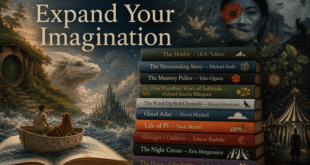
The Secret Life of Books Hidden stories. Untold truths. Every book
Top 10 Most Underrated Novels of the 19th Century That Every Book Lover Should Read
When readers think of nineteenth-century literature, titles such as Pride and Prejudice, Jane Eyre, War and Peace, Les Misérables, and Moby-Dick usually dominate the conversation. These celebrated works have earned their place among the greatest novels ever written, but they represent only a small part of what the nineteenth century produced.
The 1800s witnessed an extraordinary explosion of literary creativity. Novelists explored industrialization, revolution, empire, psychological conflict, changing gender roles, scientific progress, and the moral dilemmas of rapidly transforming societies. While many masterpieces became household names, countless exceptional novels gradually faded into the background—not because they lacked quality, but because they were overshadowed by more famous works or changing literary trends.
For modern readers, these overlooked books offer a rewarding experience. Their themes remain strikingly relevant, their characters feel deeply human, and their storytelling rivals many of the classics that dominate today’s reading lists.
Whether you’re a lifelong lover of classic literature or just beginning to explore nineteenth-century fiction, these underrated novels deserve a place on your bookshelf.

Why Read Underrated 19th-Century Novels?
Choosing lesser-known classics allows readers to discover fresh perspectives that often challenge familiar ideas about literature.
Many forgotten novels explore issues that remain surprisingly modern, including:
– Social inequality
– Women’s independence
– Political corruption
– Industrialization
– War and trauma
– Personal identity
– Family conflict
– Wealth and ambition
Because they are read less frequently, these novels often feel like hidden treasures waiting to be discovered.
10. The Woodlanders by Thomas Hardy (1887)
Thomas Hardy is widely remembered for Tess of the d’Urbervilles and Far from the Madding Crowd, yet many literary critics consider The Woodlanders among his finest achievements.
Set within the ancient forests of rural England, the novel follows Grace Melbury, Giles Winterborne, and Edred Fitzpiers as their lives become entangled through love, social ambition, and personal sacrifice. Hardy transforms the woodland landscape into a living presence that reflects the emotions and destinies of his characters.
Unlike many Victorian novels filled with dramatic twists, The Woodlanders unfolds quietly, allowing readers to appreciate its emotional depth and psychological realism. Hardy examines how education, class divisions, and personal choices slowly reshape lives that once seemed destined for happiness.
One of the novel’s greatest strengths is its compassionate treatment of ordinary people. Rather than presenting heroes and villains, Hardy creates deeply human characters who struggle against circumstances beyond their control.
Why It’s Underrated
Although critics often praise the novel, it receives far less attention than Hardy’s later tragedies. Readers who discover it frequently describe it as one of the most moving novels in English literature.
Why You Should Read It
– Beautiful descriptions of nature
– Complex emotional relationships
– Timeless themes of love, regret, and fate
– One of Hardy’s richest character studies
9. North and South by Elizabeth Gaskell (1855)
Often described simply as a Victorian romance, North and South is far more than a love story. Elizabeth Gaskell brilliantly captures the tension between England’s traditional rural culture and its rapidly expanding industrial cities.
The novel follows Margaret Hale, whose family relocates from southern England to the manufacturing town of Milton. There she meets John Thornton, a successful mill owner whose worldview differs sharply from her own.
Rather than relying on romance alone, Gaskell explores labor disputes, workers’ rights, poverty, economic change, and class conflict with remarkable fairness. She presents both factory owners and workers as complex human beings, encouraging readers to understand multiple perspectives.
Margaret herself stands among Victorian literature’s strongest heroines. Intelligent, compassionate, and independent, she consistently challenges social expectations while remaining deeply empathetic.
Why It’s Underrated
Although it has gained popularity through television adaptations, it remains overshadowed by novels such as Jane Eyre and Pride and Prejudice, despite offering equally memorable characters and equally compelling storytelling.
Why You Should Read It
– Intelligent romance
– Rich historical setting
– Insightful social commentary
– Strong female protagonist
8. The Awakening by Kate Chopin (1899)
When The Awakening first appeared in 1899, many critics condemned it for challenging traditional ideas about marriage and motherhood. Today, it is recognized as one of the earliest and most influential feminist novels in American literature.
The story centers on Edna Pontellier, a married woman who gradually awakens to desires and ambitions that conflict with society’s expectations.
Chopin writes with extraordinary subtlety, allowing readers to witness Edna’s emotional transformation rather than simply describing it. Every conversation, relationship, and quiet moment contributes to a powerful portrait of a woman searching for personal freedom.
Modern readers are often surprised by how contemporary the novel feels. Questions about identity, independence, relationships, and self-discovery remain just as relevant today.
Why It’s Underrated
Although widely studied in universities, it is still absent from many general reading lists and deserves a broader audience beyond academic settings.
Why You Should Read It
– Beautiful literary prose
– Psychological depth
– Historically groundbreaking
– Timeless exploration of identity
7. The Red Badge of Courage by Stephen Crane (1895)
Unlike many war novels that celebrate heroism, Stephen Crane focuses on the private fears and emotional struggles of one ordinary young soldier during the American Civil War.
Henry Fleming dreams of becoming a hero, but once he experiences combat, fear overwhelms him. His journey becomes less about military victory and more about understanding courage itself.
Remarkably, Crane never fought in the Civil War. Yet his psychological insight was so convincing that many readers believed he had personally witnessed the battles.
The novel transformed war literature by emphasizing internal conflict over battlefield spectacle. Instead of glorifying violence, Crane presents war as confusing, terrifying, and deeply human.
Why It’s Underrated
It is often assigned in classrooms but rarely recommended for general readers, despite being one of the greatest psychological novels ever written.
Why You Should Read It
– Fast-paced narrative
– Exceptional psychological realism
– Honest portrayal of fear and courage
– Influential in modern war literature
6. The House of the Seven Gables by Nathaniel Hawthorne (1851)
Nathaniel Hawthorne is best known for The Scarlet Letter, but The House of the Seven Gables deserves equal recognition. Combining Gothic fiction with psychological realism, it tells the story of the Pyncheon family, whose grand ancestral home is overshadowed by a centuries-old curse.
The novel explores how guilt, greed, pride, and injustice can echo across generations. Hawthorne suggests that while the past cannot be erased, individuals still have the power to choose forgiveness over revenge. This balance of mystery and moral reflection gives the story lasting emotional weight.
The mansion itself is one of literature’s most memorable settings. Its dark rooms, hidden corners, and decaying grandeur mirror the emotional burdens carried by its inhabitants, creating an atmosphere that is haunting without relying on supernatural horror.
Literary Significance
Hawthorne masterfully blends symbolism with realistic characterization. Rather than focusing solely on suspense, he asks profound questions about inheritance, justice, and whether people can truly escape the consequences of history.
Why It’s Underrated
Because The Scarlet Letter dominates Hawthorne’s reputation, many readers never discover this equally compelling novel. Yet many critics consider it one of the finest examples of American Gothic literature.
Why You Should Read It
– Atmospheric Gothic setting
– Rich symbolism
– Memorable characters
– Timeless themes of redemption and forgiveness
5. The Egoist by George Meredith (1879)
George Meredith’s The Egoist is one of Victorian literature’s sharpest social satires. At its center is Sir Willoughby Patterne, a wealthy and charming gentleman whose overwhelming vanity makes him incapable of understanding the people around him.
As his engagement begins to fall apart, Meredith exposes the subtle ways pride and self-importance can destroy relationships. The novel is both humorous and psychologically insightful, revealing how easily intelligence and privilege can be undermined by unchecked ego.
Meredith’s style is witty, sophisticated, and filled with clever observations about society. Although it demands careful reading, patient readers are rewarded with one of the most original character studies in English literature.
Literary Significance
Long before psychology became a formal discipline, Meredith explored narcissism, emotional manipulation, and the illusions people create about themselves. His understanding of human behavior feels remarkably modern.
Why It’s Underrated
Its reputation for complex prose has discouraged many readers, but beneath the elegant language lies a deeply entertaining and surprisingly contemporary novel.
Why You Should Read It
– Brilliant social satire
– Psychological depth
– Clever dialogue
– One of Victorian literature’s funniest novels
4. The Return of the Native by Thomas Hardy (1878)
Few novelists understood the relationship between people and nature as deeply as Thomas Hardy. In The Return of the Native, the wild landscape of Egdon Heath becomes more than a setting—it is almost a character in its own right.
The novel follows Eustacia Vye, a passionate young woman who dreams of escaping her isolated rural home for a more exciting life. Her ambitions collide with those of Clym Yeobright, whose own hopes for the future lead to tragedy.
Hardy explores themes of ambition, desire, fate, and disappointment with extraordinary emotional honesty. His characters are neither purely heroic nor villainous; they are ordinary people struggling against forces they cannot fully control.
The novel also reflects Hardy’s belief that nature is indifferent to human dreams. Egdon Heath remains constant while generations of people experience love, heartbreak, and loss beneath its vast skies.
Literary Significance
The Return of the Native is often regarded as one of Hardy’s greatest artistic achievements. Its blend of poetic description, philosophical reflection, and psychological realism influenced countless twentieth-century writers.
Why It’s Underrated
Readers often choose Tess of the d’Urbervilles or Jude the Obscure first, leaving this masterpiece overlooked despite its extraordinary literary power.
Why You Should Read It
– One of literature’s greatest settings
– Rich symbolism
– Complex, unforgettable characters
– Powerful exploration of destinies
3. Romola by George Eliot (1863)
Unlike George Eliot’s famous English novels, Romola transports readers to Renaissance Florence during one of the most turbulent periods in Italian history.
The novel follows Romola de’ Bardi, the intelligent daughter of a blind scholar, whose marriage to the ambitious Tito Melema slowly reveals the conflict between personal happiness and moral responsibility.
Eliot spent years researching Renaissance politics, philosophy, religion, and culture before writing the novel. The result is a richly detailed historical epic that combines factual accuracy with unforgettable storytelling.
Beyond its historical setting, Romola asks timeless questions about integrity, loyalty, leadership, and the responsibilities individuals owe to society. These moral dilemmas give the novel lasting relevance.
Literary Significance
Many literary scholars consider Romola one of the finest historical novels ever written because it seamlessly blends history with profound psychological insight.
Why It’s Underrated
Its Renaissance setting intimidates some readers, causing many to overlook one of George Eliot’s most ambitious and rewarding works.
Why You Should Read It
– Fascinating historical background
– Outstanding character development
– Deep philosophical themes
– Beautiful, intelligent prose
Why These Forgotten Classics Still Matter
Many nineteenth-century novels disappeared from popular reading lists not because they lacked quality, but because literary fashions changed over time. Yet the themes explored in these books remain remarkably relevant.
Questions about identity, ambition, social inequality, political corruption, love, morality, and personal freedom continue to shape modern society. Reading these overlooked classics allows us to see that many of today’s challenges were already being explored by great writers more than a century ago.
These novels also reward readers with slower, richer storytelling, complex characters, and ideas that stay with you long after the final page.
2. The Way We Live Now by Anthony Trollope (1875)
If one nineteenth-century novel feels astonishingly modern, it is The Way We Live Now. Anthony Trollope wrote this sweeping satire in response to financial scandals and political corruption in Victorian Britain, but its themes remain just as relevant today.
At the center of the novel is Augustus Melmotte, a wealthy financier whose fortune and reputation are built on deception. As politicians, businessmen, journalists, and social elites compete for wealth and status, Trollope reveals how greed can corrupt both individuals and institutions.
What makes the novel remarkable is its realism. Rather than presenting simple heroes and villains, Trollope shows how ambition, vanity, and social pressure influence people from every class of society.
Many readers are surprised by how contemporary the novel feels. Its exploration of financial bubbles, celebrity culture, media influence, and public manipulation mirrors many issues found in the twenty-first century.
Literary Significance
Widely regarded as Trollope’s masterpiece, the novel combines unforgettable characters with sharp political and social commentary. It remains one of the greatest satires ever written in English.
Why It’s Underrated
Although admired by critics, it is often overshadowed by the works of Charles Dickens and George Eliot. Readers looking for intelligent social fiction frequently overlook this extraordinary novel.
Why You Should Read It
– Brilliant satire of wealth and corruption
– Surprisingly relevant to modern society
– Large cast of memorable characters
– Rich political and social commentary
1. The Charterhouse of Parma by Stendhal (1839)
Among Europe’s greatest novels, The Charterhouse of Parma deserves far more recognition from English-speaking readers.
The story follows Fabrice del Dongo, an idealistic young Italian nobleman whose life is shaped by war, politics, romance, and ambition. Beginning during the Napoleonic era, the novel takes readers through battlefields, royal courts, prisons, and monasteries while exploring the unpredictable nature of human destiny.
One of the book’s most celebrated scenes is Fabrice’s experience at the Battle of Waterloo. Instead of presenting a heroic military spectacle, Stendhal depicts the confusion and uncertainty experienced by an ordinary participant—a technique that influenced later writers such as Leo Tolstoy and Ernest Hemingway.
The novel also features unforgettable women, especially Gina Sanseverina, whose intelligence, loyalty, and political skill make her one of literature’s most fascinating characters.
Literary Significance
Stendhal pioneered psychological realism by focusing on his characters’ inner thoughts and emotional conflicts. His influence can be seen in later novelists across Europe and beyond.
Why It’s Underrated
Overshadowed by The Red and the Black, The Charterhouse of Parma rarely appears on popular reading lists despite being considered one of the greatest European novels ever written.
Why You Should Read It
– Epic historical adventure
– Rich political intrigue
– Complex psychological characters
– A masterpiece of European literature
Final Thoughts
The nineteenth century produced far more masterpieces than the handful of novels most readers know today. While celebrated classics deserve their reputation, these overlooked works remind us that literary history is full of hidden treasures waiting to be rediscovered.
Whether you’re drawn to Gothic fiction, historical epics, psychological realism, social satire, or tragic romance, these novels offer unforgettable stories and profound insights into the human experience.
Reading underrated classics expands your understanding of literature while introducing you to extraordinary authors whose work deserves a much wider audience.
If you’ve already read the famous nineteenth-century classics, let this list be your guide to discovering ten remarkable novels that continue to inspire readers and scholars around the world.
Frequently Asked Questions (FAQ)
What is the most underrated novel of the 19th century?
Many literary critics consider The Charterhouse of Parma by Stendhal one of the greatest overlooked masterpieces because of its influence on modern psychological fiction and historical storytelling.
Which Victorian novel deserves more attention?
The Woodlanders by Thomas Hardy and The Egoist by George Meredith are two Victorian novels that deserve far more recognition for their emotional depth and psychological insight.
Are underrated classic novels easier to read?
Some are challenging because of older language and historical settings, but novels like North and South and The Red Badge of Courage are accessible for readers new to classic literature.
Which underrated classic should beginners start with?
A great starting point is North and South by Elizabeth Gaskell. It combines compelling characters, an engaging romance, and important social themes in an approachable style.
Why should readers explore lesser-known classics?
Underrated classics often provide fresh perspectives, unforgettable characters, and timeless ideas without the familiarity of frequently discussed works. They broaden your understanding of literary history and introduce you to remarkable stories that deserve a larger audience.
Conclusion
The best books aren’t always the most famous. Hidden among the celebrated masterpieces of the nineteenth century are extraordinary novels that deserve a second life with modern readers. Whether you’re building a classics reading list or searching for your next unforgettable novel, these underrated works offer beauty, wisdom, and insight that have stood the test of time.
Which of these novels have you read—and which one will you pick up next? Share your thoughts in the comments and help more readers discover these forgotten literary gems.