The Secret Life of Books Hidden stories. Untold truths. Every book
Why Is Animal Farm Still Relevant Today?
What happens when people fight for freedom and equality, only to discover that those who take control can become just as powerful and corrupt as the leaders they replaced?
That question is at the heart of Animal Farm, George Orwell’s famous political novella. Published in 1945, the story follows a group of farm animals who rebel against their human owner because they dream of creating a society where everyone is equal. What begins as a hopeful revolution gradually becomes a new system of control.
Although Animal Farm is a short book about animals on a farm, its ideas reach far beyond its simple setting. Orwell explores propaganda, political manipulation, inequality, corruption, power, censorship, and the dangers of blindly trusting those in authority.
More than eighty years after its publication, readers continue to find these themes relevant.
The world has changed enormously since Orwell wrote the novel. Technology has transformed communication, politics, and everyday life. Yet people still struggle with many of the same questions about power and truth.
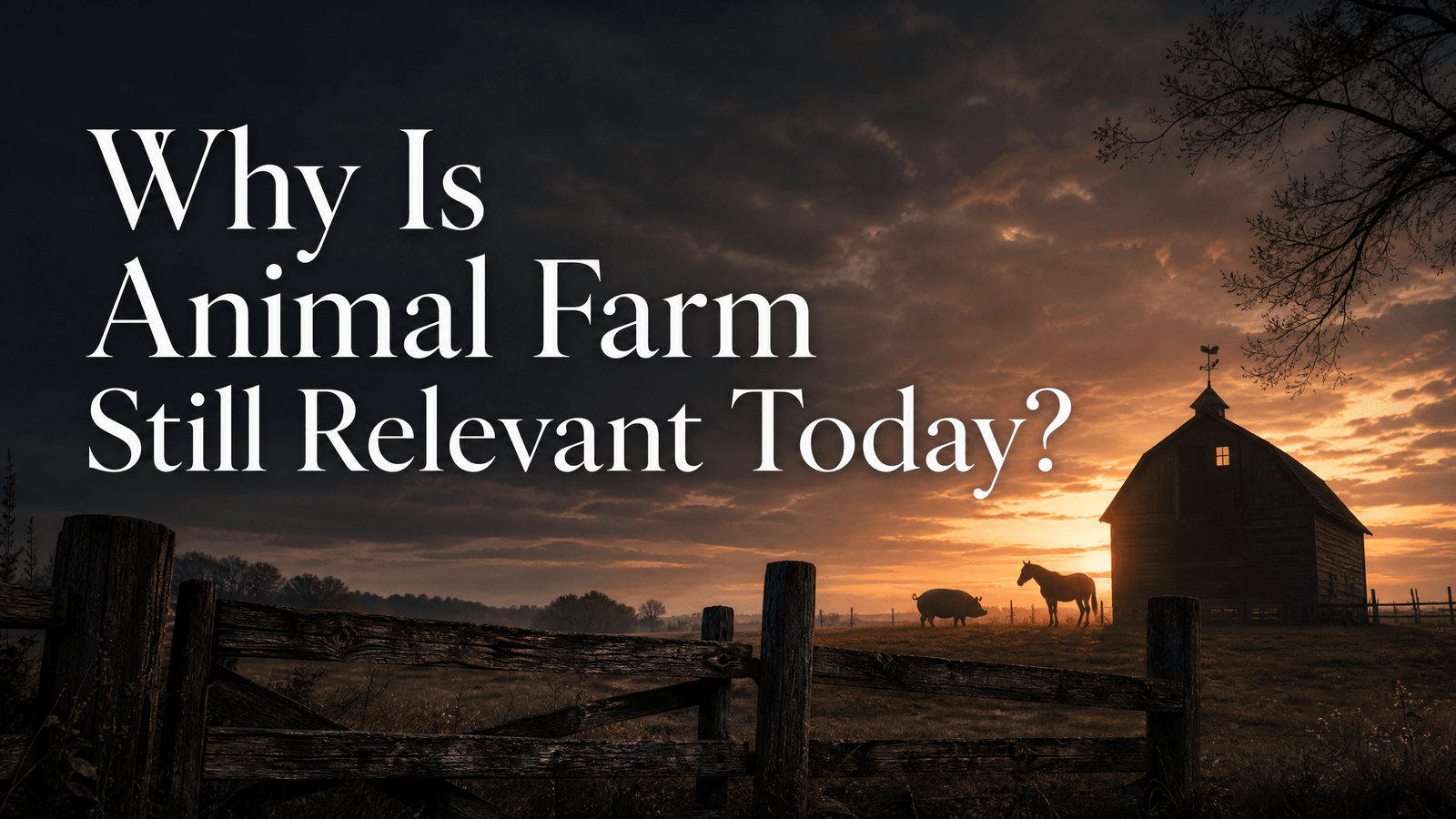
So, why is Animal Farm still relevant today?
Because Orwell’s warning is not limited to one country, one political system, or one historical moment. It is a warning about what can happen whenever power becomes more important than the principles that originally justified it.
What Is Animal Farm About?
Animal Farm begins on Manor Farm, where the animals are poorly treated by their owner, Mr. Jones. An old pig named Old Major inspires the animals with a vision of a future in which they are free from human oppression.
After Old Major dies, the animals eventually rebel and drive Mr. Jones away.
The farm now belongs to them.
At first, the revolution appears successful. The animals establish principles based on equality and believe they are creating a better society.
But the pigs gradually become more powerful. Napoleon eventually takes control and removes his rival Snowball. The animals are then subjected to increasing propaganda, fear, and manipulation.
The original ideals of the revolution slowly disappear.
By the end, the pigs have become so similar to the humans they once opposed that the other animals can no longer clearly distinguish between them.
The story is simple, but the message is deeply political and psychological.
Power Can Change Those Who Hold It
One of the main reasons Animal Farm remains relevant is its examination of power.
The animals overthrow Mr. Jones because they believe their lives will improve under a system based on equality.
But once the pigs gain authority, they begin to separate themselves from the other animals.
They take privileges for themselves and gradually change the rules that were supposed to protect equality.
Orwell shows that a movement can begin with genuine ideals and still become corrupt when its leaders are not held accountable.
This is an important lesson for any society.
It is not enough to replace one leader with another. A healthy society also needs institutions, transparency, accountability, and citizens who are willing to question those in power.
Propaganda Still Shapes Public Opinion
Perhaps the most relevant aspect of Animal Farm today is its portrayal of propaganda.
The pig Squealer is extremely skilled at manipulating information. Whenever the pigs make an unpopular decision, he provides an explanation designed to convince the other animals that the decision is necessary.
When conditions become worse, the animals are reminded that life was supposedly even worse under Mr. Jones.
When the pigs receive special treatment, there is always a justification.
The animals gradually become less confident in their own memories and more dependent on the official explanation of events.
Modern societies have access to far more information than the animals in Animal Farm, but that does not make manipulation impossible.
Political speeches, advertisements, social media posts, selective reporting, misleading headlines, and emotionally charged content can all influence how people understand events.
The lesson is not that every message is propaganda. It is that people should learn to recognize when information is being used to influence rather than simply inform.
Social Media Makes the Warning Even More Interesting
Orwell could not have predicted social media, smartphones, or the internet.
Yet Animal Farm offers useful ideas for understanding the modern information environment.
Today, information can spread around the world within minutes. A false claim can be repeated thousands of times before anyone checks whether it is accurate.
People can also become surrounded by content that supports what they already believe.
This can create environments where individuals hear one version of reality repeatedly and begin to assume that it must be true.
The animals experience something similar in the novel. They have limited access to reliable information, so they become dependent on the pigs to explain what is happening.
The situations are obviously not identical, but the underlying lesson is valuable: information should be examined rather than automatically accepted.
The Importance of Knowing History
History is constantly rewritten in Animal Farm.
As Napoleon gains power, Snowball is increasingly blamed for problems on the farm. Past events are altered or presented differently. The animals struggle to remember what actually happened.
This allows Napoleon to present himself as a leader who has always been right.
The novel shows why controlling history can be so powerful.
If people cannot remember what happened before, they may find it difficult to recognize when promises have been broken.
This remains relevant today because societies constantly debate how history should be remembered and taught.
Historical disagreement is normal, but deliberately distorting evidence or erasing inconvenient facts can prevent people from learning from the past.
Orwell’s message is simple: memory matters.
Language Can Be Used to Manipulate
The changing commandments are among the most memorable parts of Animal Farm.
The animals begin with clear principles designed to protect equality. But as the pigs gain power, the commandments are gradually altered.
The changes are often small enough that the animals do not immediately recognize what has happened.
This shows how language can be used to normalize behavior that would previously have been considered unacceptable.
Words can clarify reality, but they can also disguise it.
A government, organization, or leader can use carefully chosen language to make harmful actions sound necessary, reasonable, or even beneficial.
That is why understanding language matters.
When people encounter political slogans, official statements, or persuasive claims, they should pay attention not only to what is being said but also to what is being avoided.
Inequality Does Not Disappear Automatically
The animals begin their revolution with the belief that everyone should be equal.
Yet inequality returns.
The pigs gradually receive better food, greater comfort, and more authority. The other animals continue to work while receiving fewer benefits.
This is one of the novel’s most important warnings.
A society can use the language of equality while still creating large differences in wealth and power.
That idea remains relevant because economic inequality continues to be debated around the world.
People still ask who benefits most from economic systems, who has access to opportunities, and whether political power is distributed fairly.
Animal Farm does not provide a complete economic theory. Instead, it encourages readers to look at the difference between what a society claims to value and how resources and power are actually distributed.
Boxer Shows the Danger of Blind Loyalty
Boxer is one of the most tragic characters in the novel.
He is hardworking, loyal, and sincere. He believes strongly in the revolution and repeatedly responds to difficulties by working harder.
His loyalty is admirable, but it also makes him vulnerable.
Boxer trusts the leadership even when there are reasons to question it.
Through Boxer, Orwell shows that good intentions are not enough to protect people from exploitation.
Hard work matters, but so do education, awareness, and the ability to recognize when someone is taking advantage of your loyalty.
The character remains powerful because people today can also become deeply committed to leaders, organizations, political movements, or communities.
Loyalty can be valuable, but blind loyalty can become dangerous.
Fear Makes People Easier to Control
Napoleon does not rely on propaganda alone.
He also uses fear.
The dogs become his instruments of intimidation, making it dangerous for the animals to openly challenge his authority.
This creates an environment where people may remain silent even when they disagree.
Fear can prevent opposition before opposition has a chance to grow.
That is an important lesson for understanding authoritarian systems. People do not necessarily need to agree with a leader in order to obey them. Sometimes they simply need to believe that resistance is too dangerous.
The novel therefore shows how propaganda and fear can work together.
Propaganda tells people what they should believe, while fear discourages them from saying otherwise.
The Slogan “Four Legs Good, Two Legs Bad”
The sheep’s repeated slogan is one of Orwell’s clearest examples of simplified political messaging.
The animals repeat the phrase without really thinking about its meaning.
Later, the slogan changes as the pigs’ interests change.
The important point is not the specific slogan itself. It is what the slogan represents.
Complex political questions are often reduced to simple statements that are easy to remember and repeat.
Simple messages can be useful, but they become dangerous when they replace genuine thought.
Modern political communication often relies on short slogans, emotional phrases, and easily shareable statements.
Animal Farm encourages us to pause before accepting a simple answer to a complicated problem.
The Animals Slowly Lose Their Freedom
One of the most disturbing parts of the novel is how gradually the animals lose control of their own revolution.
Their freedom does not disappear all at once.
Instead, one change follows another.
A rule is modified. A privilege is accepted. A critic is removed. A new explanation is introduced. A difficult question becomes dangerous.
Eventually, the animals have almost no ability to challenge the system.
This gradual process is important because people often imagine the loss of freedom as something dramatic.
Orwell suggests that it can also happen through small changes that people accept one at a time.
That makes the novel a warning about complacency as much as dictatorship.
Why Is Animal Farm Relevant to Politics?
The novel remains relevant to political discussions because it explores a pattern that can appear in many different contexts.
A movement begins by promising change.
A leader gains authority.
Opposition is weakened.
Information is controlled.
Rules are changed.
Privileges become concentrated.
Eventually, the original promises may have little connection with reality.
This does not mean every political movement follows the same path. History is much more complicated than a single fictional story.
But Orwell gives readers a useful framework for recognizing warning signs of concentrated power.
It Teaches Critical Thinking
Perhaps the most valuable lesson of Animal Farm is the importance of thinking independently.
The animals often know that something feels wrong, but they struggle to explain why.
They have poor access to reliable information and limited confidence in their own memories.
The novel encourages readers to do the opposite.
Question claims.
Check evidence.
Remember history.
Listen to different perspectives.
Pay attention when someone tries to discourage questions.
Critical thinking does not mean automatically rejecting authority. It means being willing to examine claims before accepting them.
That is an important skill in any society.
Animal Farm Is Not Only About Governments
Although the novel is strongly connected to political power, its lessons can be applied more broadly.
Any organization can experience problems when authority becomes concentrated and accountability disappears.
The same ideas can be considered in workplaces, institutions, communities, organizations, and even personal relationships.
Whenever one person or group gains too much control and others become afraid to question them, the possibility of abuse increases.
This broader interpretation is one reason the book continues to be useful.
It is not simply a historical commentary.
It is a study of power.
Why Does Animal Farm Still Matter to Young Readers?
Young readers can find Animal Farm especially valuable because it introduces complicated political and social ideas in a simple form.
The story encourages questions about fairness, leadership, responsibility, persuasion, and freedom.
It also teaches an important lesson about information.
Young people today encounter enormous amounts of information every day. Learning how to distinguish evidence from persuasion is increasingly important.
Animal Farm provides an accessible way to begin thinking about these issues.
The story may be short, but its questions are large.
Is Animal Farm Still Worth Reading?
Absolutely.
Animal Farm remains worth reading because it is short, accessible, memorable, and filled with ideas that continue to matter.
You can read it simply as a story about animals taking over a farm, but understanding its deeper symbolism makes the novel much more powerful.
It is particularly valuable for readers interested in politics, history, social inequality, propaganda, leadership, and human behavior.
It also pairs well with 1984, another Orwell novel that explores the dangers of political control.
While the two books approach the subject differently, both emphasize the importance of truth and independent thought.
What Is the Main Message of Animal Farm?
The central message of Animal Farm is that power without accountability can corrupt even movements that begin with noble ideals.
Orwell also shows that propaganda, fear, ignorance, and blind loyalty can make it easier for leaders to manipulate ordinary people.
The novel does not suggest that people should reject every form of leadership.
Instead, it reminds us that power needs limits.
People need access to reliable information. Rules need to apply consistently. Leaders need to be questioned. History needs to be remembered.
Without these protections, the promise of equality can gradually become another system of inequality.
Final Thoughts
So, why is Animal Farm still relevant today?
Because Orwell understood that the struggle for freedom does not end simply because one powerful leader has been removed.
A society can begin with hopes of equality and still become unequal. Leaders can promise to serve the people and eventually serve themselves. Information can be manipulated. History can be rewritten. Fear can silence criticism.
These are not problems belonging only to the past.
The modern world is different from Orwell’s world, but his questions remain valuable.
Who has the power?
Who controls the information?
Who benefits from the system?
Can people question those in authority?
And are the promises of equality reflected in reality?
Those questions are at the heart of Animal Farm.
That is why the book continues to be read.
It does not simply tell us what happened to a group of animals on a farm. It teaches us to pay attention to what happens when people stop questioning power.
Frequently Asked Questions
Why is Animal Farm still relevant today?
Animal Farm remains relevant because it explores propaganda, political manipulation, inequality, censorship, corruption, fear, and the abuse of power. These issues continue to appear in different forms in modern societies.
What does Animal Farm teach us about power?
The novel teaches that power can become dangerous when leaders are not held accountable. It also shows how people can gradually lose their freedom when they stop questioning those in authority.
How does Animal Farm relate to social media?
The novel’s ideas about propaganda and information control can help readers think about modern social media. False or misleading information can spread quickly, while repeated messages can influence how people understand events.
Why is propaganda important in Animal Farm?
Propaganda allows the pigs to influence how the other animals understand reality. Squealer repeatedly changes or explains information in ways that protect Napoleon’s authority.
What does Boxer represent in Animal Farm?
Boxer represents hardworking and loyal ordinary people who trust the system and its leaders. His story shows that loyalty and hard work can become dangerous when they are combined with a lack of critical questioning.
What is the main lesson of Animal Farm?
The main lesson is that unchecked power can corrupt leaders and destroy the ideals of a revolution. The novel also emphasizes the importance of critical thinking, reliable information, and remembering history.
Is Animal Farm a political book?
Yes. Animal Farm is a political allegory that explores revolution, authoritarianism, propaganda, inequality, and the abuse of political power. However, its broader ideas can also be applied to other situations involving power and control.
Is Animal Farm worth reading today?
Yes. Animal Farm is still worth reading because it is short and accessible while dealing with complex ideas about freedom, equality, leadership, propaganda, and human behavior. Its lessons remain valuable for modern readers.