The Secret Life of Books Hidden stories. Untold truths. Every book
Why Should You Read The Great Gatsby by F. Scott Fitzgerald?
What if the dream you spent your whole life chasing was never really yours to have?
That question sits quietly at the heart of The Great Gatsby, one of the most famous novels in American literature. Published in 1925, F. Scott Fitzgerald’s novel takes us into the glamorous world of wealth, parties, love, ambition, and disappointment in 1920s America. On the surface, it is a story filled with beautiful houses, expensive cars, extravagant parties, and mysterious characters. But underneath all that glamour is a much sadder story about longing, loneliness, class, memory, and the impossibility of recreating the past.
So, why should you read The Great Gatsby?
Because it is much more than a love story. Fitzgerald uses a small group of unforgettable characters to explore some of the biggest questions about human desire. What happens when we confuse wealth with happiness? Can we ever return to the past? How much of our lives is shaped by the dreams we refuse to let go of?
These questions are part of what makes The Great Gatsby such a lasting classic.
What Is The Great Gatsby About?
The story is narrated by Nick Carraway, a young man who moves to Long Island and finds himself surrounded by wealthy people living seemingly perfect lives. His neighbor is Jay Gatsby, a mysterious millionaire famous for throwing enormous parties that attract crowds of strangers.
Gatsby appears to have everything. He has money, a magnificent mansion, beautiful clothes, and an endless supply of guests. Yet there is something deeply lonely about him. His enormous parties are not really about enjoying life. They are connected to one person he hopes will eventually appear.
That person is Daisy Buchanan.
Gatsby and Daisy had fallen in love years earlier, but they were separated by circumstances, time, and social expectations. Gatsby has spent years building his wealth and creating a life that he believes will bring Daisy back to him.
When they meet again, Gatsby becomes convinced that he can recover the love they once had.
This is where the beauty and tragedy of the novel begin to come together.
Fitzgerald Shows the Danger of Chasing a Dream
One of the strongest reasons to read The Great Gatsby is its exploration of the American Dream.
The American Dream suggests that through ambition and hard work, a person can create a better life. Gatsby appears to embody that idea. He rises from a poor background and becomes enormously wealthy.
But Fitzgerald asks a more complicated question. What happens when success is not enough?
Gatsby does not want wealth simply for comfort. He wants it because he believes wealth will allow him to recreate the past and win Daisy back.
His dream becomes so powerful that reality can no longer compete with it.
This makes Gatsby both inspiring and tragic. He possesses extraordinary hope, but his hope is directed toward something that may never have existed in the way he remembers it.
Gatsby Is a Story About the Past
Perhaps the most memorable idea in the novel is Gatsby’s desire to return to the past.
He believes that if he can bring Daisy back into his life, everything that happened between them can somehow disappear. He does not simply want a future with Daisy. He wants the past to become present again.
Fitzgerald understands something deeply human here.
Many people hold onto memories of how life used to be. Sometimes we remember a person, a relationship, a place, or a particular period of our lives and imagine that returning to it would make everything right again.
But time does not work that way.
The past can be remembered, but it cannot truly be recreated.
Gatsby’s tragedy comes from refusing to accept that difference.
Daisy Buchanan Is More Complicated Than She Appears
Daisy is often remembered simply as Gatsby’s great love, but she is more complicated than that.
She is charming, beautiful, and capable of attracting people almost effortlessly. Gatsby places her on an almost impossible pedestal, turning her into the perfect symbol of everything he desires.
But Daisy is not the idealized person Gatsby imagines.
She is shaped by wealth, comfort, social expectations, and fear. Her decisions are influenced by the security her privileged world provides.
Through Daisy, Fitzgerald shows how difficult it can be to separate genuine love from social status, comfort, and expectation.
Gatsby loves an idea of Daisy as much as he loves Daisy herself.
The Novel Explores Wealth and Social Class
Another important reason to read The Great Gatsby is its treatment of wealth.
The characters may appear to live perfect lives, but Fitzgerald repeatedly shows that money does not create happiness or moral goodness.
The novel also distinguishes between different kinds of wealth.
Gatsby has enormous money, but he does not truly belong to the old social world inhabited by people such as Tom and Daisy Buchanan.
This difference matters.
Gatsby can buy the mansion. He can buy the clothes. He can throw the parties. But money cannot automatically buy acceptance into a social class that has existed for generations.
Fitzgerald uses Gatsby’s struggle to reveal the invisible boundaries created by wealth and social status.
Why Is The Great Gatsby Still Relevant Today?
Although the novel was published more than a century ago, many of its concerns remain surprisingly familiar.
People still chase wealth because they believe it will bring happiness. People still compare themselves with others. People still create carefully constructed images of success. People still idealize the past and imagine that another version of life would make them happier.
The world around Gatsby may look different from ours, but human desires have not changed very much.
Modern readers can also recognize the pressure to appear successful. Social media has made it easier than ever to present a beautiful version of life while hiding loneliness, insecurity, or disappointment.
In that sense, Gatsby’s world feels strangely familiar.
The Green Light and the Power of Symbolism
One reason The Great Gatsby is so rewarding to study is Fitzgerald’s use of symbolism.
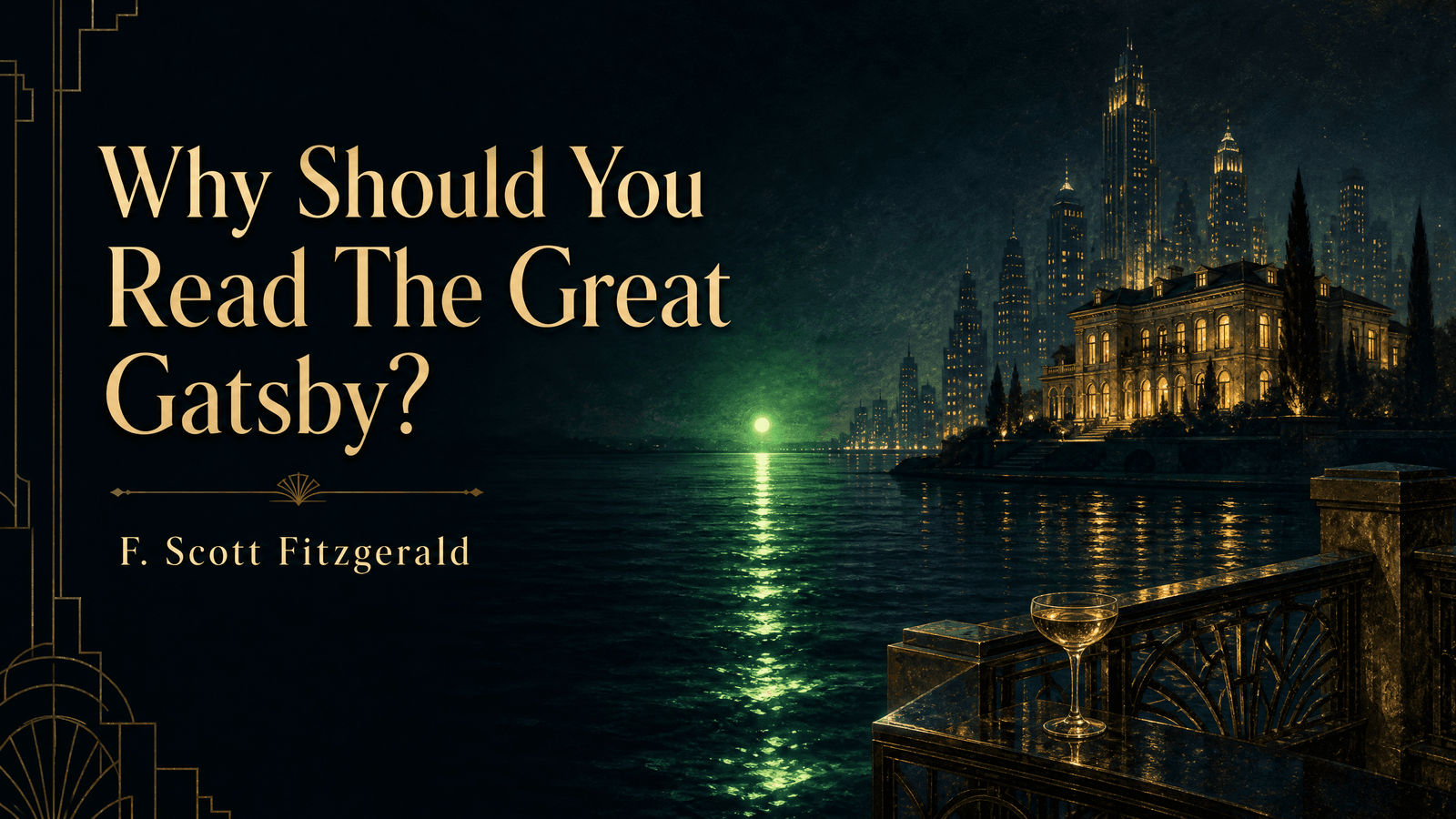
The green light at the end of Daisy’s dock is one of the most famous symbols in American literature. For Gatsby, it represents Daisy and the future he desperately wants.
But it can also represent something larger.
The green light becomes a symbol of hope, desire, ambition, and the human tendency to chase something that always seems just beyond reach.
That is what makes the symbol so powerful.
Gatsby is always moving toward something, but the moment he believes he has reached it, reality begins to destroy the dream.
The Parties Are Not What They Seem
Gatsby’s extravagant parties are among the most memorable images in the novel.
Music fills his mansion. Guests arrive in expensive clothes. Champagne flows, people dance, and strangers enjoy themselves without even knowing who Gatsby really is.
At first, this seems like a celebration of wealth and freedom.
But Fitzgerald gradually reveals the loneliness behind the spectacle.
Gatsby throws these parties because he hopes Daisy might someday appear.
The crowds surrounding him do not necessarily know him, care about him, or understand him.
His mansion is full of people, yet Gatsby himself remains deeply isolated.
That contrast is one of the saddest parts of the novel.
Nick Carraway Gives the Story Its Unique Perspective
Nick is more than a narrator who simply tells us what happens.
He watches the people around him and gradually becomes aware of the emptiness beneath their beautiful lives.
Because Nick is neither as wealthy as Tom and Daisy nor as obsessed with Gatsby’s dream, he occupies an interesting position between them.
His perspective allows Fitzgerald to reveal the difference between appearance and reality.
Nick is fascinated by Gatsby, even when he recognizes Gatsby’s flaws.
By the end of the novel, his understanding of the people around him has changed completely.
Gatsby Is a Tragic Character
Gatsby’s greatest strength is also his greatest weakness.
He believes.
He believes that the future can be made perfect. He believes that Daisy can return to him. He believes that the past can be recovered.
His extraordinary hope makes him memorable, but it also prevents him from accepting reality.
That is why Gatsby remains such a fascinating character.
He is not simply a rich man chasing a woman. He represents the human tendency to build an ideal future in our imagination and then become disappointed when real life cannot match it.
There is something heartbreaking about that.
Most people have experienced some smaller version of it.
We remember something as perfect. We imagine what might have happened. We think about what life would be like if we could go back and make a different choice.
Gatsby takes that human tendency to its extreme.
Fitzgerald’s Writing Makes the Novel Beautiful
Another reason to read The Great Gatsby is Fitzgerald’s writing.
The novel is relatively short, but its language is rich with imagery and symbolism. Fitzgerald can describe wealth and beauty while quietly suggesting the emptiness underneath them.
His prose gives the novel a dreamlike quality.
The houses, parties, cars, clothes, lights, and landscapes are visually beautiful, yet there is always a sense that something is wrong beneath the surface.
That contrast between beauty and sadness is one of Fitzgerald’s greatest achievements.
The novel can be read quickly, but its ideas stay with you.
What Is the Main Message of The Great Gatsby?
At its heart, The Great Gatsby is a story about the dangers of confusing dreams with reality.
Fitzgerald does not suggest that ambition or hope is necessarily wrong. Gatsby’s ability to imagine a better future is part of what makes him extraordinary.
The tragedy comes when his dream becomes more important than reality itself.
The novel also questions whether wealth can provide happiness, whether love can survive the passage of time, and whether people can truly escape their past.
Its answer is deeply pessimistic.
We may move forward through life, but our memories and desires often pull us backward.
Is The Great Gatsby Worth Reading?
Yes, especially if you enjoy classic literature, tragic love stories, psychological fiction, or novels that explore human nature.
It is also an excellent book for readers who enjoy stories with deeper meanings hidden beneath a simple plot.
You can read The Great Gatsby as a love story, but you can also read it as a story about wealth, class, ambition, identity, memory, loneliness, and the American Dream.
Every time you return to it, a different part of the novel may stand out.
That is one of the qualities of great literature.
Final Thoughts: Why Should You Read The Great Gatsby?
So, why should you read The Great Gatsby by F. Scott Fitzgerald?
Read it for Gatsby’s impossible dream.
Read it for Fitzgerald’s beautiful writing.
Read it for the unforgettable characters and the world of wealth and glamour they inhabit.
But most importantly, read it because the novel understands something deeply human.
We often spend our lives reaching toward something in the distance. Sometimes it is success. Sometimes it is love. Sometimes it is a person we once knew or a version of ourselves we wish we could become again.
Gatsby teaches us that dreams can give life meaning, but they can also blind us to reality.
His story is beautiful because he never stops believing.
It is tragic because what he believes in may never have been possible.
And perhaps that is why The Great Gatsby continues to speak to readers after all these years.
It reminds us that sometimes the hardest thing is not achieving a dream.
It is knowing when to let it go.
Frequently Asked Questions About The Great Gatsby
What is The Great Gatsby about?
The Great Gatsby is a novel about Jay Gatsby, a wealthy and mysterious man who tries to reunite with Daisy Buchanan, the woman he loved in the past. The story explores love, wealth, social class, ambition, memory, and the American Dream.
Why is The Great Gatsby considered a classic?
The Great Gatsby is considered a classic because of its memorable characters, beautiful writing, powerful symbolism, and exploration of universal themes such as love, ambition, wealth, loneliness, and the desire to recreate the past.
Why is Gatsby obsessed with Daisy?
Gatsby is obsessed with Daisy because he sees her as both the woman he loves and the symbol of the perfect life he has always wanted. His feelings for her become connected to his larger dream of recreating the past.
What does the green light symbolize in The Great Gatsby?
The green light symbolizes Gatsby’s hopes and desires, particularly his dream of being reunited with Daisy. More broadly, it represents the human tendency to chase a future that always seems just beyond reach.
What is the main theme of The Great Gatsby?
One of the central themes of The Great Gatsby is the conflict between dreams and reality. The novel also explores wealth, social class, love, the American Dream, memory, loneliness, and the inability to escape the past.
Why is The Great Gatsby still relevant today?
The novel remains relevant because people still struggle with wealth, social status, ambition, loneliness, relationships, and the desire to create a perfect life. Its exploration of appearances versus reality also feels particularly familiar in an age of carefully constructed public images.
Is The Great Gatsby difficult to read?
The novel is relatively short and its story is accessible, but its symbolism and deeper themes can require careful reading. Readers who take time to think about the characters and Fitzgerald’s imagery will find much more beneath the surface.
Is The Great Gatsby worth reading?
Yes. The Great Gatsby is worth reading for its beautiful prose, memorable characters, powerful symbolism, and timeless exploration of love, ambition, wealth, dreams, and the past.