The Secret Life of Books Hidden stories. Untold truths. Every book
Why Should You Read 1984 by George Orwell?
What would happen if someone else could decide not only what you do, but what you remember, believe, and even think?
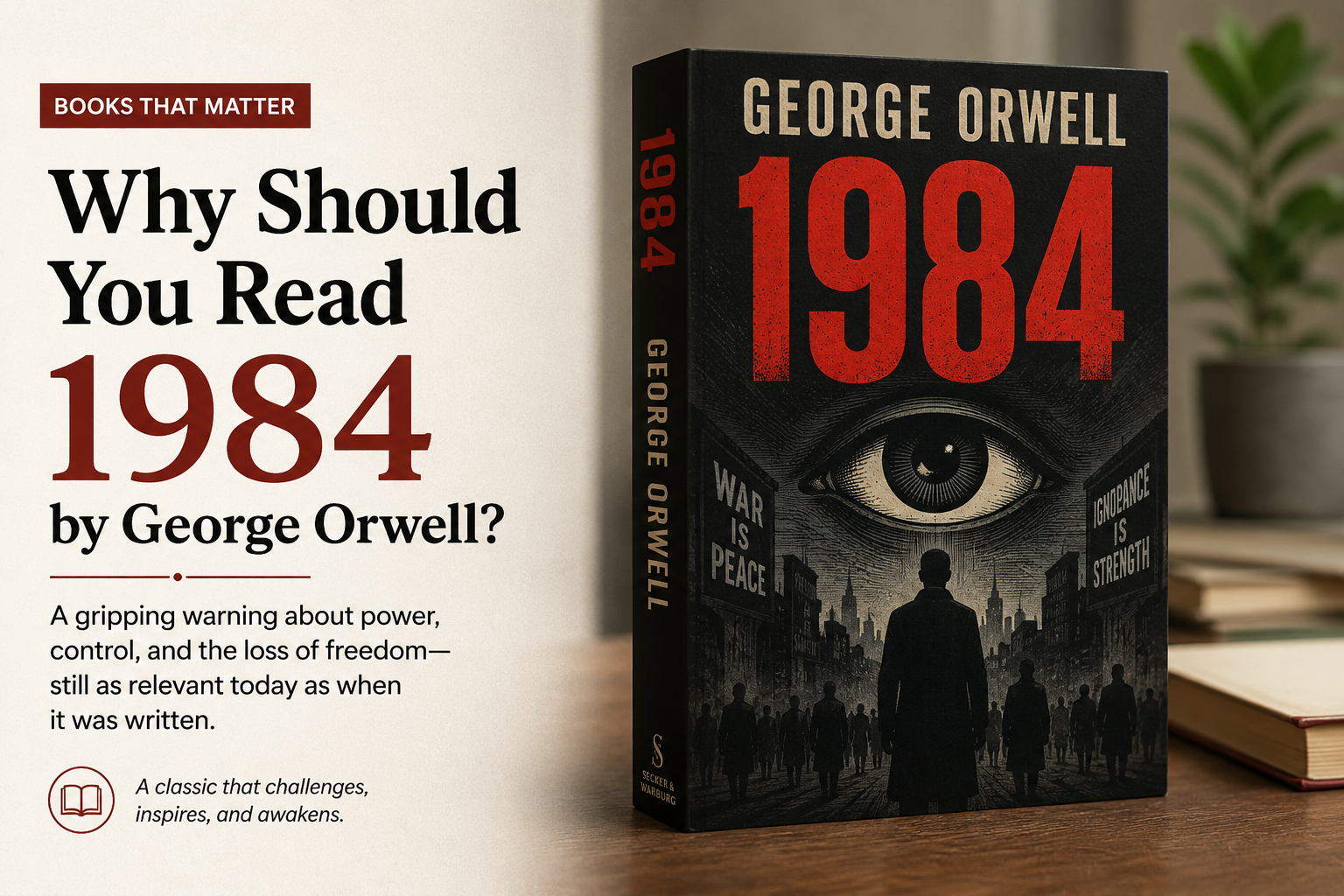
That frightening question lies at the heart of 1984, George Orwell’s dystopian masterpiece. First published in 1949, the novel imagines a society where the government watches its citizens, controls information, rewrites history, and punishes independent thought.
More than seven decades later, 1984 remains one of the most influential and thought-provoking novels ever written.
But why should you read 1984 by George Orwell?
Because it is not simply a story about a frightening future. It is a powerful warning about political power, propaganda, surveillance, language, truth, and the importance of independent thought.
What Is 1984 About?
1984 follows Winston Smith, an ordinary man living in Oceania, a totalitarian state ruled by the mysterious Party and its symbolic leader, Big Brother.
Winston works at the Ministry of Truth, where his job is to alter old newspapers and historical records so that the past always agrees with the Party’s current version of reality.
But Winston secretly hates the Party.
He begins questioning the official version of history and dreams of a world where people can think and live freely. His private rebellion becomes even more dangerous when he begins a relationship with Julia, another Party member who secretly rejects the system.
Their attempt to find freedom eventually brings them into contact with O’Brien, a powerful Party official. What follows is a disturbing exploration of political control, psychological manipulation, torture, betrayal, and the destruction of individuality.
1. 1984 Shows How Power Can Control Truth
One of the strongest reasons to read 1984 is its exploration of truth and historical memory.
The Party does not merely censor information. It continually changes the historical record.
If yesterday’s statement contradicts today’s political position, the records are altered until the contradiction disappears.
This leads to one of Orwell’s most important ideas: controlling the past can help control the present.
The novel encourages readers to ask important questions:
– Who controls the information we receive?
– Can history be manipulated?
– What happens when facts become political tools?
– How can ordinary people recognize propaganda?
These questions make 1984 much more than a dystopian novel.
2. Big Brother Makes Surveillance Terrifying
“Big Brother” has become one of the most recognizable symbols of surveillance in modern culture.
In Orwell’s fictional society, telescreens watch citizens constantly. People never know exactly when they are being observed, so they must behave as though they are always being watched.
The result is more powerful than physical surveillance alone.
People begin monitoring themselves.
This is one of the novel’s most disturbing insights: a system becomes incredibly powerful when people start censoring their own behavior because they fear being watched.
3. Orwell Shows Why Language Matters
Another reason 1984 deserves to be read is its treatment of language.
The Party creates a controlled language called Newspeak. Its purpose is not simply to introduce new vocabulary but to reduce the range of ideas people can express.
Orwell connects language with freedom of thought.
The novel asks an unsettling question:
Can controlling language eventually influence what people are capable of thinking?
This makes 1984 particularly valuable for anyone interested in literature, philosophy, politics, psychology, communication, or critical thinking.
4. The Novel Explores the Psychology of Fear
Orwell shows that political oppression does not depend only on physical force.
Fear can change human behavior from the inside.
Winston’s greatest struggle is not simply against the Party’s laws. It is against the possibility that the Party can eventually control his mind completely.
The novel explores fear, loneliness, obedience, psychological manipulation, betrayal, identity, and individual freedom.
This psychological dimension is what makes 1984 so disturbing.
The real question is not simply:
Can the government control your body?
It is:
Can it control your mind?
5. 1984 Explains How Propaganda Can Work
The Party constantly uses slogans, repetition, contradictions, and manipulated information to shape public perception.
Its famous slogans deliberately contradict ordinary logic:
“War is Peace.”
“Freedom is Slavery.”
“Ignorance is Strength.”
These contradictions illustrate the concept of doublethink—the ability to accept contradictory ideas as true when the Party demands it.
Orwell demonstrates how repeated messages can gradually weaken a person’s confidence in their own judgment.
That makes 1984 an important book for understanding propaganda and the importance of critical thinking.
6. Winston Smith Is an Unforgettable Character
Winston is not a traditional heroic figure.
He is frightened, imperfect, lonely, and uncertain.
That is precisely why he feels human.
His desire for freedom begins quietly. He writes in a diary. He questions the past. He remembers fragments of a different world. He seeks human connection.
His rebellion begins with something incredibly simple: the desire to think for himself.
Through Winston, Orwell shows how difficult resistance can become when an entire society is organized around obedience.
7. 1984 Is About More Than Politics
It is easy to describe 1984 as a political novel, but that is only part of its power.
At its deepest level, the novel is about human freedom.
It asks what makes a person an individual.
Is freedom simply being allowed to walk wherever you want?
Or does freedom require the ability to say:
“I know this is true, even if someone powerful tells me otherwise.”
Orwell’s novel suggests that freedom becomes fragile when people lose the ability to trust their own memories, perceptions, and judgment.
A society can restrict freedom gradually through fear, propaganda, censorship, surveillance, and manipulation until people no longer trust themselves.
8. Why Is 1984 Still Relevant Today?
This is perhaps the most important reason to read the novel.
The world of 1984 is fictional, but its themes remain recognizable.
Modern readers can connect the novel’s ideas to discussions about:
– Mass surveillance
– Digital privacy
– Government power
– Propaganda
– Disinformation
– Political polarization
– Censorship
– Manipulated information
– Social media
– Artificial intelligence
– Personal freedom
This does not mean that modern society is literally Oceania.
Instead, Orwell gives readers a powerful framework for thinking about what can happen when information, technology, and political power become concentrated.
That is why 1984 continues to provoke debate among readers around the world.
9. Why Did George Orwell Write 1984?
George Orwell, whose real name was Eric Arthur Blair, wrote 1984 after witnessing the rise of totalitarian politics and experiencing the ideological conflicts of his own time.
His experiences with poverty, imperialism, political extremism, and the Spanish Civil War deeply influenced his thinking.
Orwell became particularly concerned with the corruption of truth by political systems.
1984 transformed those concerns into fiction.
Rather than writing a simple political argument, Orwell created a world that allows readers to experience what extreme political control might feel like from the inside.
What Is the Main Message of 1984?
The central message of 1984 is that freedom depends upon the ability to preserve truth, independent thought, memory, and human individuality.
Orwell warns that authoritarian power becomes especially dangerous when it can influence not only what people do, but what they believe to be true.
The novel encourages readers to question information, protect intellectual independence, and recognize the importance of language and historical memory.
Is 1984 Worth Reading?
Yes, especially if you enjoy dystopian fiction, classic literature, political philosophy, psychology, or thought-provoking stories.
The novel can be uncomfortable and emotionally disturbing, but that discomfort is part of its purpose.
1984 is not designed merely to entertain.
It is designed to make you question.
And that may be its greatest strength.
Final Thoughts: Why Should You Read 1984?
So, why should you read 1984 by George Orwell?
Read it because it challenges you to think about freedom.
Read it because it shows how language can influence thought.
Read it because it explores the terrifying relationship between power and truth.
Read it because Winston Smith’s struggle reminds us that independent thought can be precious.
And read it because great literature does more than tell us about another world—it helps us examine our own.
1984 remains powerful because Orwell understood something timeless:
When people lose the freedom to question reality, they risk losing the freedom to define themselves.
Frequently Asked Questions About 1984
What is the main message of 1984?
The novel warns about the dangers of totalitarian power, surveillance, propaganda, censorship, manipulation of truth, and the destruction of individual thought.
Why is 1984 considered a classic?
1984 remains influential because it explores universal concerns about political power, freedom, truth, language, surveillance, and individuality through a memorable dystopian story.
What does Big Brother represent in 1984?
Big Brother represents the Party’s absolute authority and its constant surveillance and control over citizens.
What is Newspeak in 1984?
Newspeak is the controlled language developed by the Party to restrict vocabulary and ultimately limit independent thought.
What is doublethink in 1984?
Doublethink is the ability to accept contradictory ideas as true, reflecting the Party’s demand that citizens accept its version of reality.
Is 1984 difficult to read?
The language of 1984 is generally accessible, but its themes are complex and disturbing. Readers interested in dystopian fiction and philosophical questions will find it especially rewarding.
What are the major themes of 1984?
The major themes include surveillance, totalitarianism, propaganda, censorship, language, truth, psychological control, individuality, fear, love, and freedom.
Who is the main character in 1984?
The main character is Winston Smith, a government worker who secretly questions the Party’s control over society and begins searching for truth and personal freedom.