The Secret Life of Books Hidden stories. Untold truths. Every book
Shakespeare’s Most Savage Insults
The Bard’s Bite: Deconstructing Shakespeare’s Savage Tongue
William Shakespeare is celebrated for his sonnets and tragedies, but his true mastery of language is perhaps most evident in his insults. Far from the crude profanity of modern slang, a Shakespearean “burn” is a literary feat—a precise blend of metaphor, social commentary, and biting rhythm.
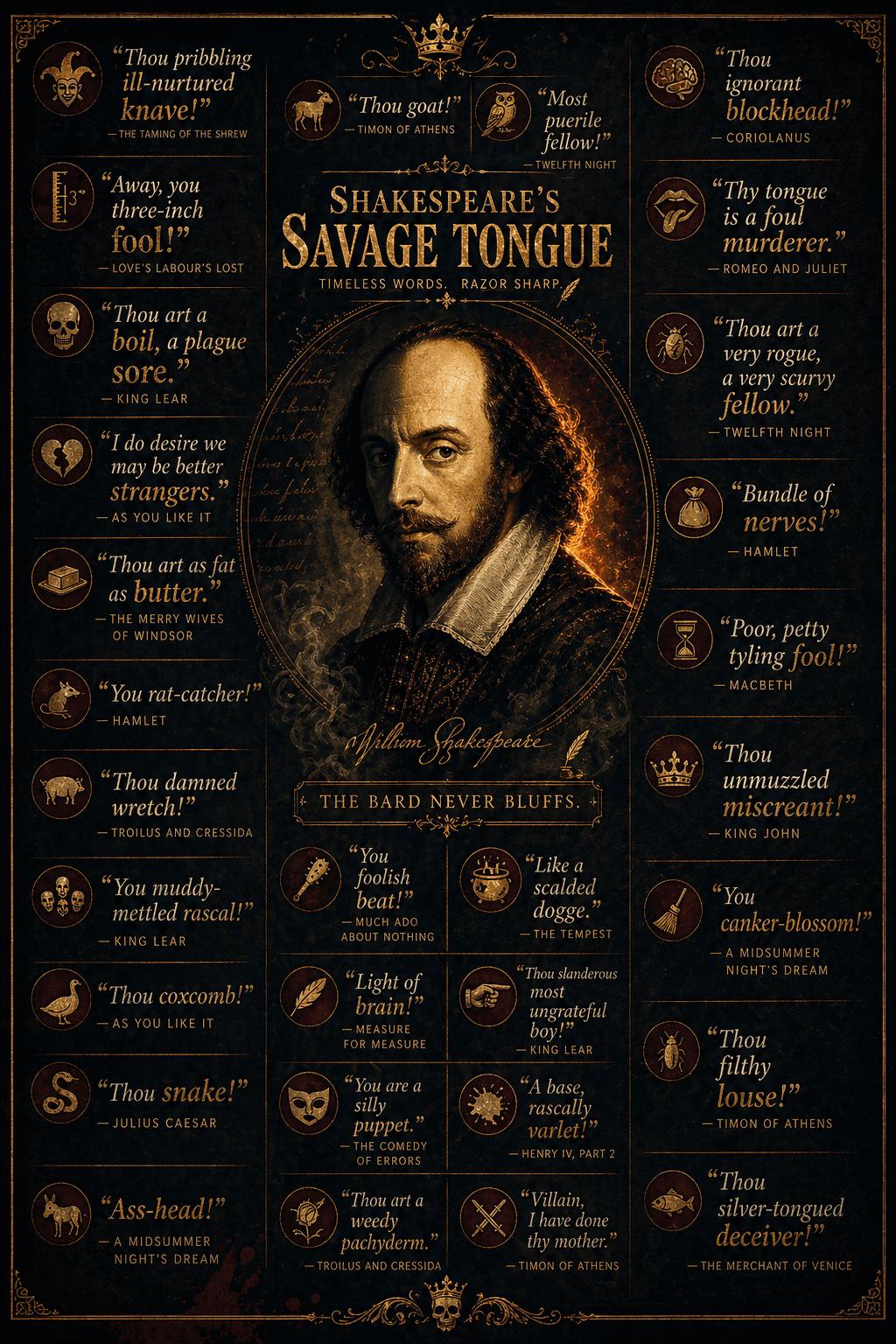
1. The Anatomy of an Elizabethan Insult
Shakespearean insults generally fall into three categories:
Physical Deformity or Illness: Comparing someone to a “boil” or a “plague sore” (King Lear) tapped into the genuine medical fears of the era.
Animalistic Comparisons: Calling someone a “rat-catcher” (Hamlet) or “thou filthy louse” (Timon of Athens) stripped them of their human dignity.
Intellectual Deficiency: Terms like “light of brain” (Measure for Measure) or “ignorant blockhead” (Coriolanus) were the ultimate slights in an era that prized wit.
2. Deep Dives: Meaning and Context
1. “Thou art a boil, a plague sore.”
Source: King Lear
Meaning: You are a disgusting, painful infection on the body of society.
Context: King Lear is screaming at his daughter, Goneril, after she strips him of his authority and soldiers.
Literary Significance: This highlights the theme of corruption. Lear views his own flesh and blood as a disease, suggesting that the “Great Chain of Being” is breaking and the world is becoming physically sick.
2. “I do desire we may be better strangers.”
Source: As You Like It
Meaning: I hope we never speak to each other again; the more distance between us, the better.
Context: Orlando says this to the melancholy Jacques. It is a witty, polite way of saying “get lost.”
Literary Significance: This is a subversion of social norms. By using the word “better”—usually reserved for becoming “better friends”—Shakespeare creates a sharp irony that emphasizes the character’s dislike without raising his voice.
3. “You canker-blossom!”
Source: A Midsummer Night’s Dream
Meaning: A parasite that eats the heart of a flower; a “love-thief.”
Context: Hermia shouts this at Helena when she believes Helena has used her height and “charms” to steal Lysander’s heart.
Literary Significance: Shakespeare uses nature imagery to describe betrayal. It’s a metaphor for how jealousy and deceit can destroy something as beautiful as a flower or a friendship.
4. “Villain, I have done thy mother.”
Source: Timon of Athens (Note: A similar, more famous version appears in Titus Andronicus)
Meaning: Exactly what it sounds like—the original “your mom” joke.
Context: Usually used to assert dominance or prove that the speaker has “conquered” the other person’s family honor.
Literary Significance: It proves that crude humor has always had a place in high art. It serves to instantly de-escalate a formal argument into a raw, street-level brawl.
5. “Thou art as fat as butter.”
Source: The Merry Wives of Windsor
Meaning: You are physically soft, oily, and excessive.
Context: Often directed at Falstaff, Shakespeare’s greatest comic character, who is famous for his gluttony and massive ego.
Literary Significance: This is an example of Hyperbole. By comparing a human to a slab of butter, Shakespeare makes the insult “slippery” and comedic, rather than purely hateful.
6. “Thou art a weedy pachyderm.”
Source: Troilus and Cressida
Context: Used during the Trojan War to describe slow-witted or stubborn warriors.
Literary Significance: The use of “Pachyderm” (elephant) shows Shakespeare’s interest in the exotic. It suggests that the person is not just stupid, but also lacks “feeling” or sensitivity.
7. “Away, you three-inch fool!”
Source: Love’s Labour’s Lost
Meaning: You are tiny, insignificant, and have a short temper (or perhaps a jab at masculinity).
Context: Used during a heated exchange to belittle the opponent’s stature and presence.
Literary Significance: Shakespeare frequently uses physical measurements to mock ego. It reduces a man’s entire personality down to a measly three inches, making his anger look ridiculous.
8. “Thou unmuzzled miscreant!”
Source: King John
Meaning: You are a dangerous, lawless criminal who hasn’t been properly restrained.
Context: A high-stakes political insult used during a confrontation between royal factions.
Literary Significance: The word “unmuzzled” implies the person is a rabid animal, while “miscreant” suggests they have no moral or religious compass. It’s an attack on both their nature and their soul.
Themes:
Animal Imagery: Notice how often he uses goat, snake, dogge, rat, and louse. To be “animal-like” was the ultimate insult to an Elizabethan, as humans were supposed to be “above” beasts.
Medical Horror: In an age of the Black Death, calling someone a plague sore or canker carried a weight of genuine terror that we don’t feel today.
The Power of “Thou”: In Shakespeare’s time, “Thou” was used for friends or social inferiors. Using “Thou” to an enemy or someone of high rank was an intentional act of disrespect.
3. The Power of Wordplay
The image features the phrase “Thou art a weedy pachyderm” (Troilus and Cressida). This is a masterclass in creative vocabulary. By combining “weedy” (unwanted, overgrowing) with “pachyderm” (thick-skinned animal, like an elephant), Shakespeare suggests someone who is both physically grotesque and emotionally oblivious.
Similarly, “Thou unmuzzled miscreant” (King John) uses alliteration to add a rhythmic “slap” to the words. The “unmuzzled” part suggests the person is a rabid dog that should be restrained, while “miscreant” attacks their very soul and character.
- 4. Why These Insults Still Matter
Shakespeare’s insults are significant because they served a narrative purpose. They weren’t just filler; they defined character dynamics:
Status: Lower-class characters often used earthy, animal-based insults.
Intellect: Noble characters used sharp, “silver-tongued” irony to win verbal duels.
Emotion: The insults often signal the exact moment a character loses their grip on reality or patience.
Conclusion: A Legacy of Wit
The image reminds us that the “Savage Tongue” of the Bard was never about being “mean”—it was about being precise. Whether it’s calling someone a “bundle of nerves” or a “three-inch fool,” Shakespeare proves that if you’re going to offend someone, you should at least do it with style.
”The Bard never bluffs.” — These words remain as sharp today as they were in the 16th century.