The Secret Life of Books Hidden stories. Untold truths. Every book
Banned Book Spotlight: Crime and Punishment by Fyodor Dostoevsky
Why the Book Still Matters Today
Published in 1866, Crime and Punishment is a psychological masterpiece set in 19th-century Russia. It follows Rodion Raskolnikov, a young man who commits a murder and is then consumed by guilt, fear, and moral questioning.
Even today, the novel remains deeply relevant because it explores conscience, morality, justice, and the psychological cost of believing one is “above” the rules of society.
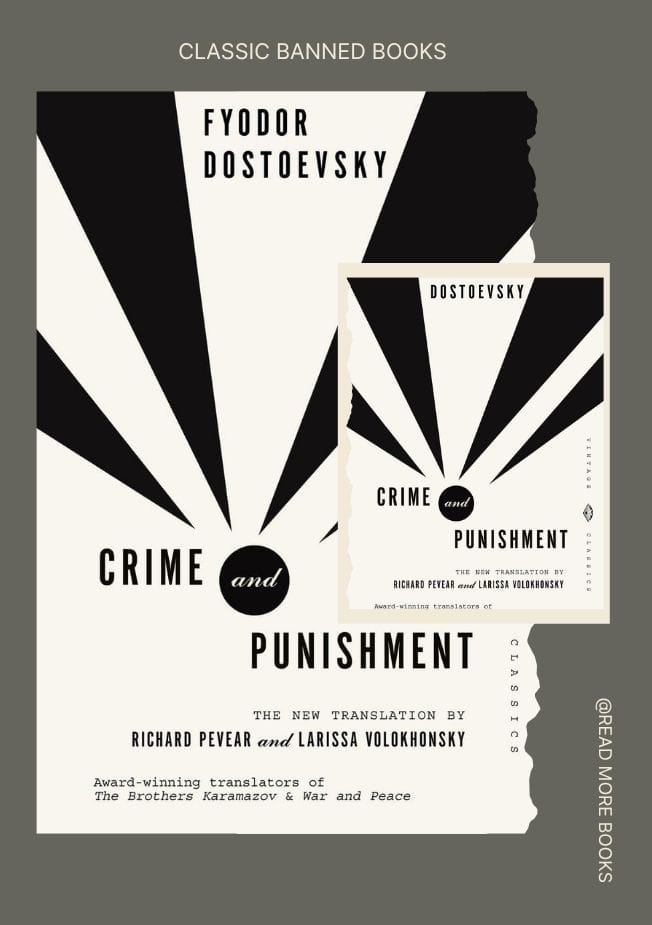
Content and Themes
Beneath its dark narrative lies intense philosophical exploration:
Guilt and conscience – Psychological torment becomes central after the crime.
Morality vs. ideology – Raskolnikov’s theory of “extraordinary men” is tested.
Justice and redemption – The novel questions what true punishment really is.
Poverty and desperation – Social conditions shape human choices.
Faith and suffering – Spiritual struggle becomes a path toward meaning.
Its focus on inner psychology made it groundbreaking.
About the Author: Fyodor Dostoevsky
Fyodor Dostoevsky was a Russian writer known for his deep psychological insight and exploration of moral and existential questions. His works often examine suffering, faith, and the complexity of human nature.
Crime and Punishment is one of his most influential novels and a cornerstone of psychological fiction.
Why Crime and Punishment Was Banned or Challenged
The novel faced criticism and concern in some contexts due to:
Violence and murder themes – Central focus on a detailed crime.
Moral and philosophical controversy – Challenges ideas of justice and morality.
Psychological intensity – Deep depiction of mental distress and guilt.
Religious and ideological debates – Exploration of faith, redemption, and ethics.
Its raw psychological realism made it both controversial and influential.
Final Thought
Crime and Punishment was not written to glorify crime—but to examine the human mind after it crosses moral boundaries. It shows that punishment is not only legal, but deeply psychological.