The Secret Life of Books Hidden stories. Untold truths. Every book
“Ozymandias” by Percy Bysshe Shelley: Meaning, Context, and Literary Significance
Introduction
Few poems in English literature capture the collapse of human pride as powerfully as Ozymandias by Percy Bysshe Shelley. Written in 1817 and published in 1818, the poem remains one of the most widely studied works of Romantic poetry because of its timeless message about power, ambition, and the inevitable destruction caused by time.
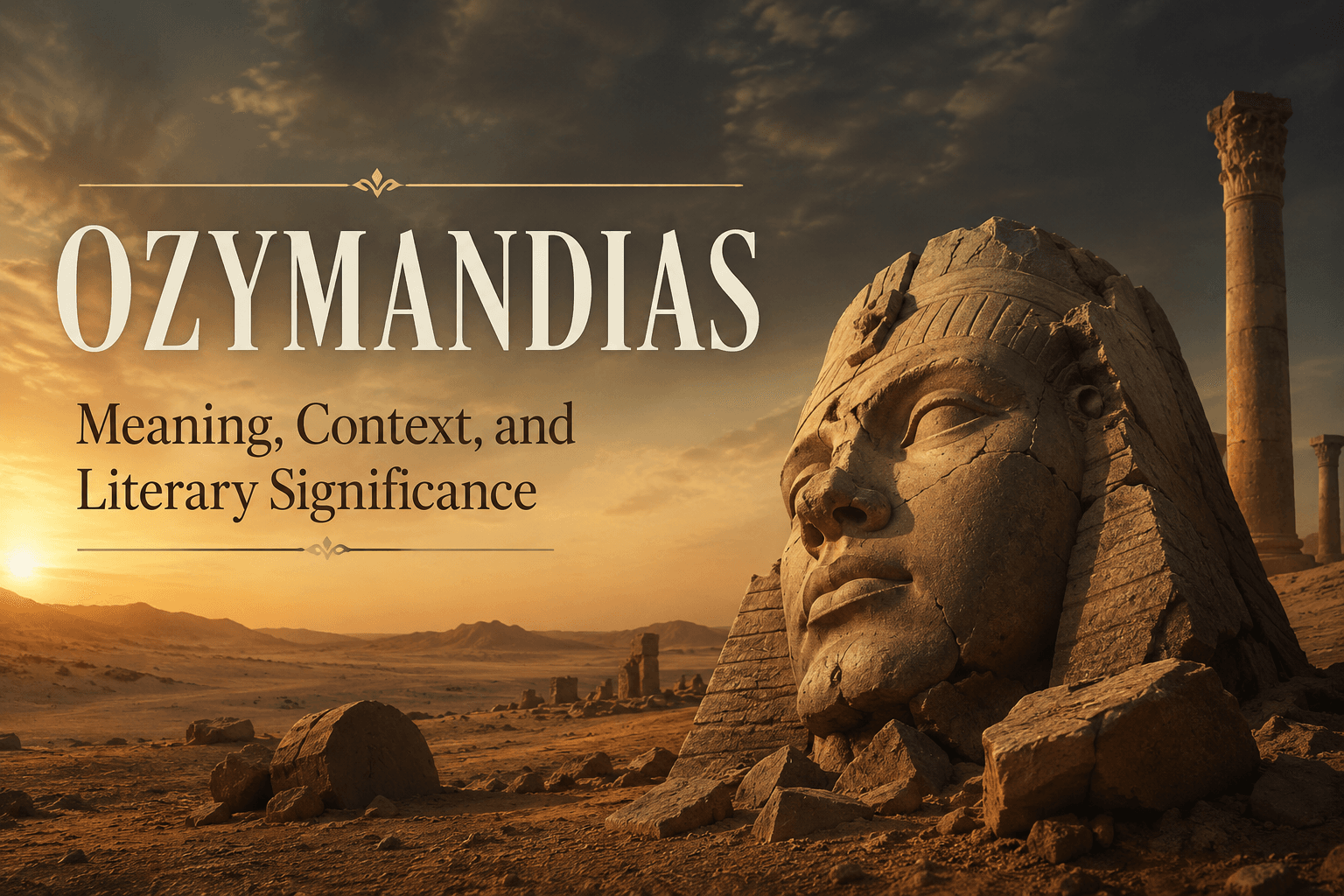
At first glance, the poem appears simple: a traveler describes the ruined statue of a once-great king standing alone in the desert. Yet beneath this image lies a profound meditation on political authority, human arrogance, artistic immortality, and the fragility of civilization itself.
Even after two centuries, “Ozymandias” continues to resonate in the modern world because it speaks directly to empires, dictators, celebrities, corporations, and every individual who believes their achievements will last forever.
Historical Context of the Poem
“Ozymandias” was written during a period of enormous political upheaval in Europe. The French Revolution had shaken old systems of monarchy, and the rise and fall of Napoleon Bonaparte demonstrated how quickly political power could rise and collapse.
Shelley himself was deeply critical of tyranny and authoritarian rule. He believed that rulers who sought absolute power were ultimately doomed because time destroys all human institutions.
The title “Ozymandias” refers to Ramses II, an ancient Egyptian pharaoh often considered one of the most powerful rulers in history. Greek historians referred to him as Ozymandias. During Shelley’s time, European fascination with ancient Egypt was increasing, especially after archaeological discoveries revealed the ruins of forgotten civilizations.
Shelley transformed this historical fascination into a philosophical reflection on impermanence.
Summary of the Poem
The poem begins with the speaker meeting a traveler from an ancient land. The traveler describes a shattered statue standing in the desert:
- Two enormous stone legs remain standing.
- Nearby lies the broken face of the ruler.
- The face still carries an expression of arrogance, pride, and cruelty.
- On the pedestal are the famous words:
“My name is Ozymandias, King of Kings; Look on my Works, ye Mighty, and despair!”
However, the irony becomes immediately clear. Around the ruins there is nothing left except endless empty desert.
The king who once believed his greatness would last forever has been erased by time.
Meaning of “Ozymandias”
The Illusion of Power
The central idea of the poem is that political and human power is temporary. Ozymandias believed himself invincible, yet his empire vanished completely.
Shelley suggests that no ruler, empire, or civilization can escape decay.
This theme remains relevant today because history repeatedly shows the collapse of powerful nations, governments, and leaders that once appeared unstoppable.
Pride and Human Arrogance
The poem also explores human ego and vanity. Ozymandias calls himself the “King of Kings,” believing himself superior to everyone else.
Like exponential decay, human glory diminishes over time no matter how powerful it once seemed. Shelley uses the ruined statue to expose the foolishness of believing that fame or authority can become eternal.
The irony of the poem is devastating: the king wanted immortality, but all that survived was evidence of his failure.
The Power of Time
Time functions almost like an invisible character in the poem. Armies, monuments, and empires disappear, but time continues endlessly.
The empty desert surrounding the ruins symbolizes eternity itself. Human achievements are temporary interruptions in a universe that ultimately erases everything.
This gives the poem both a tragic and philosophical quality.
Art Outlives Power
Interestingly, although Ozymandias’s kingdom vanished, the sculptor’s artistic work survived.
The sculptor captured the ruler’s “sneer of cold command,” preserving the king’s personality forever. In this sense, art becomes more powerful than political authority.
Shelley subtly suggests that artists and writers may achieve a form of immortality that rulers cannot.
Ironically, today the world remembers Ozymandias not because of his empire, but because of Shelley’s poem.
Literary Devices in the Poem
Irony
Irony is the poem’s most important literary device.
Ozymandias commands others to “look on my works,” expecting admiration and fear. Instead, readers see emptiness and destruction.
The contrast between the king’s boast and reality creates the poem’s powerful effect.
Imagery
Shelley uses vivid visual imagery to create the ruined desert landscape.
Readers can clearly imagine:
- the shattered stone face,
- the broken statue,
- the endless sands,
- and the silence surrounding the ruins.
This imagery emphasizes isolation and decay.
Symbolism
The statue symbolizes:
- political power,
- human ambition,
- and the desire for immortality.
The desert symbolizes:
- time,
- emptiness,
- and nature’s indifference to human achievements.
Structure and Form
The poem is a sonnet, traditionally associated with love poetry. Shelley transforms this romantic form into a meditation on destruction and mortality.
The irregular rhyme scheme also creates a sense of instability, reflecting the collapse of Ozymandias’s empire.
Romanticism in “Ozymandias”
As a Romantic poet, Shelley emphasized:
- emotion,
- imagination,
- nature,
- and criticism of oppressive institutions.
The poem reflects Romantic ideals in several ways:
Nature vs Human Power
Nature ultimately destroys human monuments and empires.
Critique of Tyranny
Shelley condemns rulers who abuse power and seek domination.
Emotional and Philosophical Depth
The poem explores existential questions about mortality and human significance.
Modern Interpretation of “Ozymandias”
Modern readers often interpret the poem as a warning against:
- dictatorship,
- political arrogance,
- corporate greed,
- celebrity culture,
- and obsession with legacy.
Today, powerful leaders still attempt to create monuments, brands, and systems designed to preserve their importance forever. Yet history repeatedly demonstrates how quickly fame disappears.
In the digital age, the poem has become even more relevant. Social media encourages people to construct permanent public identities, but trends, fame, and influence often vanish rapidly.
“Ozymandias” reminds modern society that permanence is largely an illusion.
Why the Poem Still Matters Today
The lasting relevance of “Ozymandias” comes from its universal truth: everything human eventually fades.
The poem continues to matter because:
- empires still rise and fall,
- leaders still become consumed by pride,
- societies still believe their systems are permanent,
- and individuals still seek immortality through wealth, fame, or influence.
Shelley’s message remains timeless because human nature itself has not changed.
Conclusion
Ozymandias is far more than a poem about a ruined statue in the desert. It is a profound reflection on mortality, power, pride, and the inevitable destruction brought by time.
Through irony, symbolism, and haunting imagery, Percy Bysshe Shelley exposes the fragility of human ambition and reminds readers that no empire lasts forever.
The poem endures because it speaks to every age. Whether applied to ancient kings, modern governments, or digital fame, its warning remains the same:
human power is temporary, but time is eternal.