The Secret Life of Books Hidden stories. Untold truths. Every book
Is 1984 Worth Reading?
What if a novel written decades ago could still make you question the world around you today? George Orwell’s 1984 is one of those books that does exactly that. First published in 1949, the novel presents a disturbing vision of a society where the government controls information, watches its citizens, manipulates history, and even tries to control what people are allowed to think.
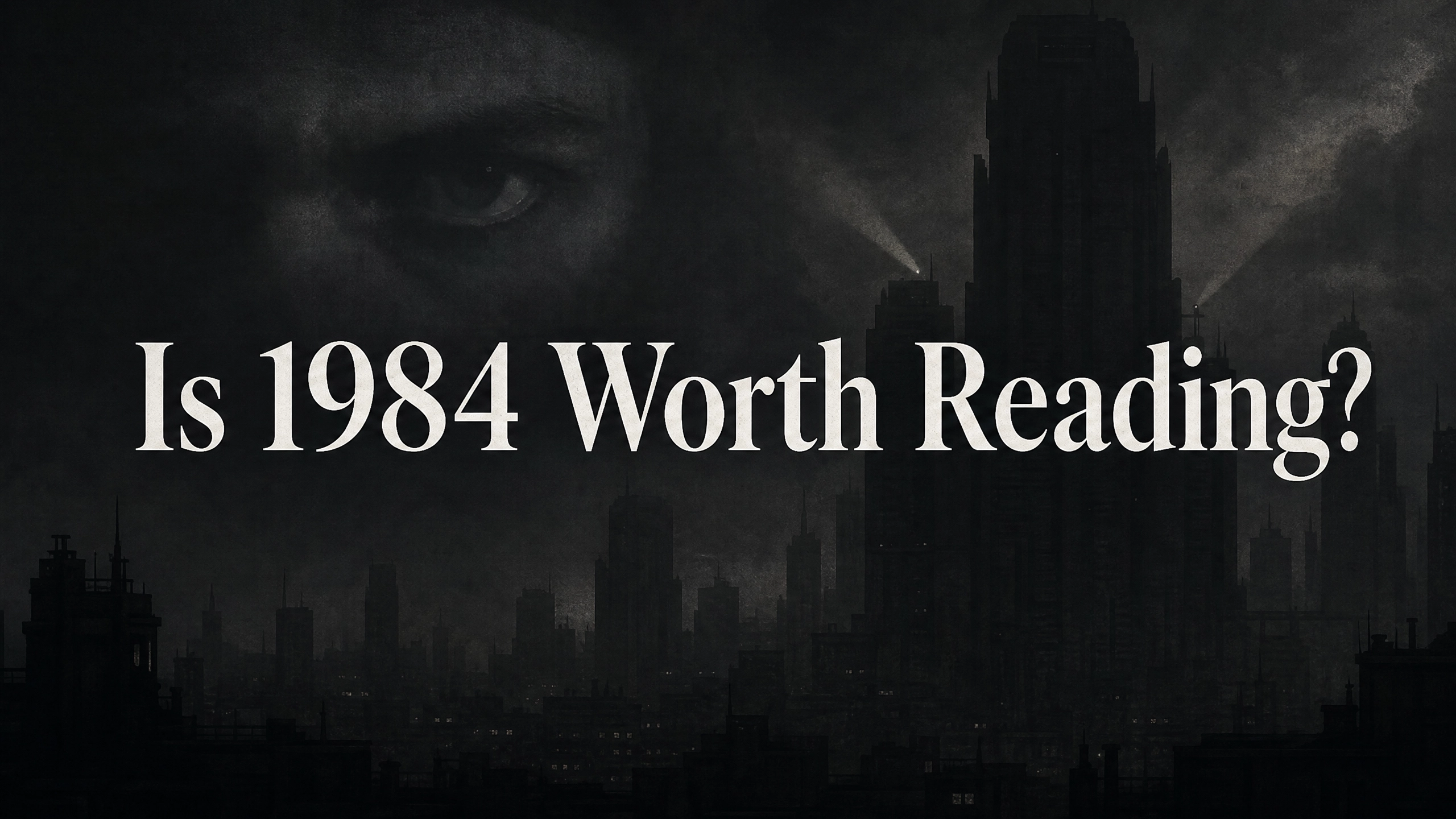
So, is 1984 worth reading? Yes, especially if you are interested in power, freedom, politics, technology, propaganda, human psychology, or the question of what happens when truth itself becomes controlled. It is not always an easy or comfortable book, but that is part of its lasting power. Orwell does not simply tell readers about an oppressive society. He encourages them to think about how such a society could develop and how ordinary people might respond to it.
What Is 1984 About?
1984 follows Winston Smith, an ordinary man living in Oceania under the control of the Party and its mysterious leader, Big Brother. Winston works at the Ministry of Truth, where his job is to alter old newspapers and historical records so that the past always agrees with the Party’s current version of reality.
Although Winston appears to be a small part of the system, he secretly dislikes the Party. He begins to question the official version of history and wonders whether another kind of life is possible. His desire for truth and freedom eventually leads him into dangerous rebellion.
The novel becomes much more than a story about one man’s struggle. It explores what happens when a government gains enough power to control not only people’s actions but also their memories, language, relationships, and beliefs.
Why Is 1984 Still Worth Reading?
One of the biggest reasons to read 1984 is that its central questions have not disappeared. Orwell was writing about totalitarianism and political control, but the novel raises broader questions about how information shapes our understanding of reality.
Today, people are surrounded by an enormous amount of information. News, social media, advertising, political messaging, videos, algorithms, and online discussions constantly compete for our attention. We may have more access to information than ever before, yet that does not automatically mean it is easier to recognize what is true.
This makes Orwell’s ideas especially interesting. 1984 encourages readers to ask who controls information, how language influences thought, and what happens when people stop questioning the information presented to them.
The Novel Makes You Think About Freedom
Freedom in 1984 is not simply the freedom to go wherever you want. Orwell presents a much deeper idea of freedom: the ability to think independently.
Winston’s greatest rebellion is not simply what he does. It is what he thinks. The Party wants to reach inside people’s minds and make them accept contradictions as truth. If the government can determine what people believe, then physical control becomes much easier.
This idea gives the novel its psychological intensity. It asks an uncomfortable question: Can a person truly be free if they are afraid to think differently?
That question remains meaningful long after the final page.
Big Brother and the Fear of Constant Surveillance
The phrase “Big Brother is watching you” has become one of the most recognizable ideas associated with 1984. In the novel, citizens live under constant surveillance. They never know exactly when they are being watched, so they learn to behave as though they are always being observed.
The frightening part is not only the existence of surveillance. It is the psychological effect of knowing that surveillance may be happening at any moment.
Modern technology makes this theme particularly interesting. Smartphones, cameras, online platforms, location services, and digital records have created new conversations about privacy and surveillance.
Modern society is obviously not identical to Orwell’s fictional world, and it would be misleading to say that every modern technology is a direct example of 1984. However, the novel gives readers a useful framework for thinking about privacy and the amount of information collected about people.
Orwell’s Ideas About Truth Are Powerful
Perhaps the most disturbing idea in 1984 is the Party’s attempt to control truth.
Winston’s job requires him to rewrite the past. If an old newspaper contains information that no longer supports the Party, he changes it. The original version effectively disappears.
This creates an important distinction between what happened and what people are allowed to remember.
The novel therefore asks readers to consider what happens when historical facts can be manipulated and people lose access to reliable records. Without a trustworthy understanding of the past, it becomes much harder to challenge those who control the present.
That idea makes 1984 valuable not only as literature but also as a book about critical thinking.
Newspeak Shows the Power of Language
Another fascinating part of the novel is Newspeak, the Party’s controlled language.
The purpose of Newspeak is not simply to create new vocabulary. It is designed to reduce the range of thoughts people can express. If certain ideas become difficult or impossible to articulate, questioning the system can become more difficult as well.
Orwell was deeply interested in the relationship between language and political power. 1984 shows how words can influence the way people understand reality.
This is one reason the book is frequently discussed in literature, politics, philosophy, journalism, and communication studies.
Winston Smith Is an Unforgettable Character
Winston is not a traditional heroic character. He is frightened, uncertain, lonely, and often powerless. He does not possess extraordinary strength or intelligence. He is simply someone who begins to wonder whether the world around him is really what the Party says it is.
That makes him relatable.
His desire to remember the past, discover the truth, experience love, and make independent choices gives the story an emotional dimension. His struggle reminds us that political oppression is ultimately experienced by individual human beings.
Through Winston, Orwell makes enormous ideas about government and power personal.
The Relationship Between Winston and Julia
Winston’s relationship with Julia adds another important layer to the novel.
Their relationship represents intimacy in a society that attempts to regulate human relationships. The Party does not want people forming strong personal loyalties that could compete with loyalty to the state.
Their connection therefore becomes more than a romantic subplot. It becomes a form of personal resistance.
At the same time, their relationship reveals Winston’s vulnerability. The novel repeatedly shows how authoritarian power can interfere with even the most private parts of human life.
1984 Is Not an Easy Read
There is an important reason some readers struggle with 1984: it is intentionally bleak.
The world Orwell creates is oppressive, uncomfortable, and psychologically disturbing. The novel does not provide an easy escape or a simple message that everything will eventually work out.
Some readers may also find the political ideas and philosophical discussions slower than those in a modern thriller. The book requires attention, particularly when Orwell explores concepts such as doublethink, Newspeak, historical manipulation, and the nature of truth.
But if you are willing to read slowly and think about the ideas, those same qualities become some of the novel’s greatest strengths.
Is 1984 Good for Young Readers?
For older teenagers and young adults, 1984 can be an especially valuable book.
It introduces difficult ideas about government, propaganda, censorship, freedom, individuality, and human psychology through a compelling story. Rather than presenting these subjects as abstract concepts, Orwell shows what they might feel like from the perspective of someone living inside such a system.
However, younger readers should be prepared for disturbing themes and a dark atmosphere. It is not a light introduction to dystopian fiction.
What Can You Learn From 1984?
Reading 1984 can encourage several important habits of thought.
First, it teaches readers to question information rather than accepting every claim automatically. Second, it demonstrates why independent thought matters. Third, it highlights the importance of preserving history and reliable records. Finally, it shows how language, fear, and repeated messaging can influence human behavior.
Perhaps the most valuable lesson is that freedom can disappear gradually. People may not always lose freedom through one dramatic event. Sometimes control grows through fear, normalization, manipulation, and the gradual acceptance of restrictions.
Is 1984 Better Than Its Reputation?
1984 is often treated as a book everyone should read, but it is worth separating its reputation from the actual reading experience.
It is not necessarily enjoyable in the traditional sense. It is dark, unsettling, and sometimes emotionally exhausting. But “worth reading” does not always mean entertaining.
Some books are worth reading because they make you laugh. Others are worth reading because they change the way you think.
1984 belongs strongly to the second category.
Its greatest achievement is that it can leave you looking at ordinary things differently. Words such as propaganda, censorship, surveillance, truth, privacy, and political language may seem familiar, but Orwell gives them a deeper emotional meaning.
Is 1984 Still Relevant Today?
Yes, but its relevance should be understood thoughtfully.
The world today is not the same as Orwell’s Oceania. Most modern societies do not resemble the extreme dictatorship presented in the novel. However, the questions Orwell raises remain important.
How easily can misinformation spread? How does propaganda influence public opinion? What happens when people live inside separate information bubbles? How much privacy should individuals have? Can political language hide uncomfortable realities? How important is an independent press? What happens when people become afraid to express unpopular opinions?
These questions make 1984 more than a historical dystopian novel.
They make it a book that can be discussed alongside the realities of modern communication and technology.
Should You Read 1984 If You Don’t Like Politics?
Absolutely.
Politics is an important part of the novel, but 1984 is also about love, loneliness, fear, memory, identity, language, relationships, and the human desire for freedom.
You do not need to be deeply interested in politics to appreciate the story. If you enjoy psychological fiction or dystopian novels, you can approach it simply as the story of a man trying to hold on to his individuality in a world designed to destroy it.
Is 1984 Worth Reading More Than Once?
It can be.
The first reading often focuses on the story and Winston’s experience. A second reading can reveal more about Orwell’s ideas concerning language, political power, propaganda, history, and psychological control.
Knowing where the story is going can also make certain details more noticeable. Small elements that seem ordinary at first may carry greater meaning when you understand the structure of the world Orwell has created.
Like many important classics, 1984 can become a different book at different stages of your life.
What Is the Main Message of 1984?
At its heart, 1984 is a warning about unchecked power and the destruction of individual freedom.
Orwell suggests that controlling people physically is only one form of power. The more extreme form is controlling what people believe to be true.
When those in power can manipulate language, history, information, and fear, they can begin to influence how people understand reality itself.
That is what makes the novel so disturbing. Its greatest warning is not simply that governments can watch people. It is that power becomes especially dangerous when it can make people doubt their own memories, thoughts, and understanding of reality.
Final Thoughts: Is 1984 Worth Reading?
Yes, 1984 is absolutely worth reading.
You should read it if you want a novel that challenges your ideas about freedom, truth, privacy, language, propaganda, and power. You should read it if you enjoy dystopian fiction that goes beyond an exciting story and asks difficult questions about human nature.
It may not be a comfortable book, and it is certainly not a cheerful one. But that is precisely why it remains so memorable.
More than seventy years after its publication, 1984 continues to ask a question that every generation should consider: What happens when people surrender the ability to think for themselves?
That question is what makes Orwell’s novel worth returning to.
Frequently Asked Questions
Is 1984 worth reading today?
Yes. The novel remains valuable because its themes of surveillance, propaganda, censorship, political power, language, privacy, and independent thought continue to provoke discussion.
Is 1984 difficult to read?
The writing itself is generally accessible, but the ideas can be difficult and disturbing. Readers should expect a dark atmosphere and several philosophical and political concepts that require reflection.
What is the main reason to read 1984?
One of the main reasons is its exploration of how power can influence information, language, memory, and thought. It encourages readers to think critically about the world around them.
Is 1984 a good book for teenagers?
For mature teenagers, it can be an excellent introduction to dystopian literature and ideas about freedom and political control. However, its dark themes may not be suitable for every younger reader.
Why is 1984 considered a classic?
It combines a powerful story with ideas that have remained influential for generations. Concepts such as Big Brother, Newspeak, doublethink, and thought control have become part of modern cultural vocabulary.
Is 1984 depressing?
Yes, the novel is intentionally bleak and contains disturbing material. Its darkness is an important part of its warning about authoritarian power.
What books should I read after 1984?
Readers who enjoy 1984 may also want to explore other dystopian and politically challenging works such as Brave New World by Aldous Huxley, Fahrenheit 451 by Ray Bradbury, and Animal Farm by George Orwell.
Is 1984 still relevant to modern society?
Its fictional society should not be treated as a direct description of modern life, but many of its questions about surveillance, propaganda, privacy, language, information, and truth remain highly relevant.