The Secret Life of Books Hidden stories. Untold truths. Every book
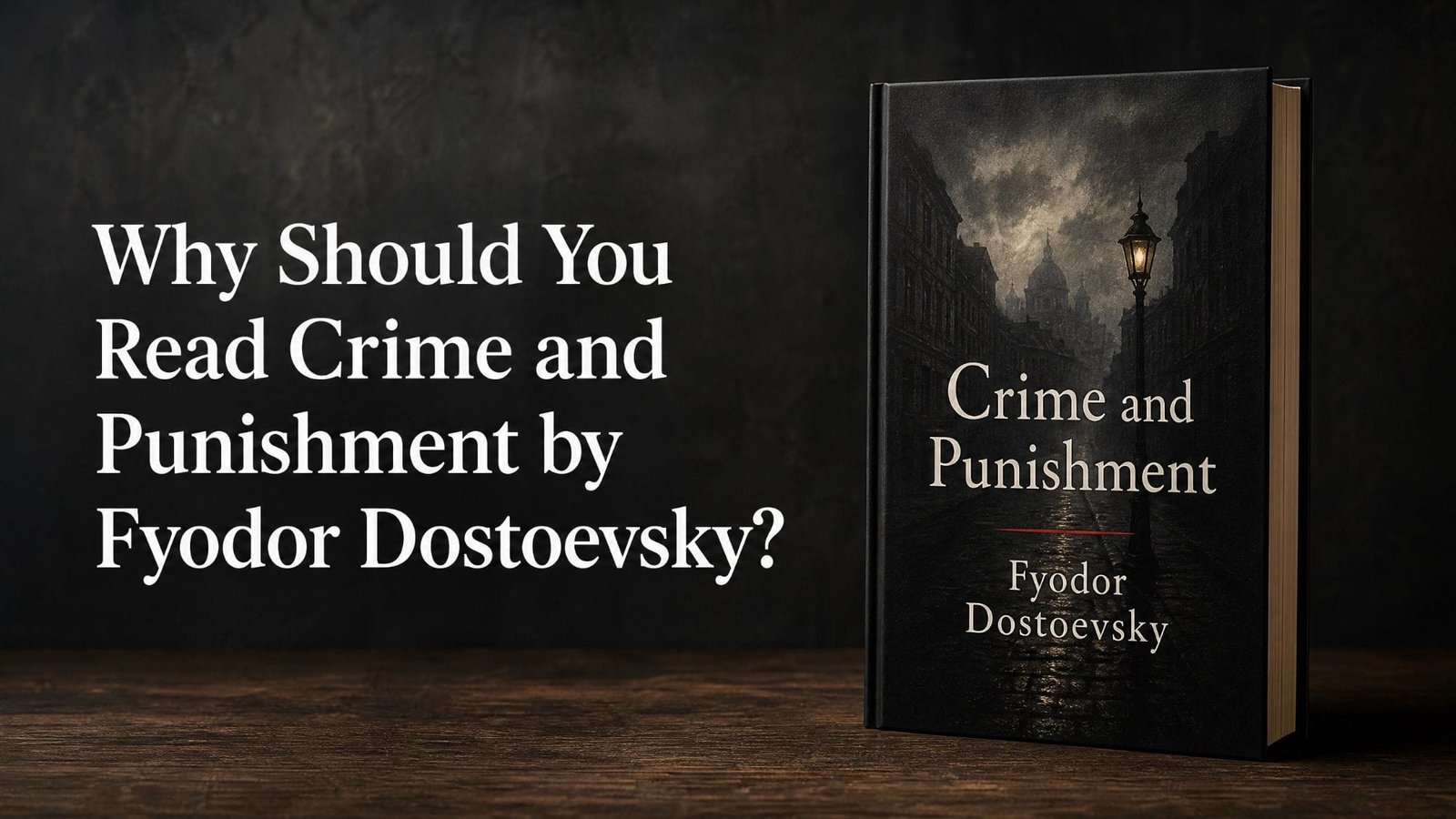
Why Should You Read Crime and Punishment by Fyodor Dostoevsky?
What happens when a person convinces himself that he is above the rules that everyone else must follow?
Fyodor Dostoevsky’s Crime and Punishment is not simply a novel about a murder. It is a psychological journey into guilt, morality, poverty, pride, suffering, and redemption. First published in 1866, the novel follows Rodion Raskolnikov, a poor former student living in St. Petersburg who becomes convinced that certain extraordinary people have the right to break moral laws if their actions might lead to something greater.
He eventually puts his theory to the test, but what follows is very different from the victory he imagined.
Instead of freedom, he finds himself trapped by fear, guilt, isolation, and his own conscience.
That is what makes Crime and Punishment such a powerful novel. Dostoevsky is less interested in the crime itself than in what happens inside the mind of the person who commits it.
What Is Crime and Punishment About?
The novel centers on Raskolnikov, a young man who lives in extreme poverty and has withdrawn from society. Intelligent but deeply troubled, he develops a theory that humanity can be divided into ordinary and extraordinary people.
According to his thinking, extraordinary individuals may be justified in breaking moral laws if they are pursuing a greater purpose. He uses historical figures such as Napoleon to support his ideas.
Raskolnikov eventually murders a pawnbroker, believing that he can justify the act intellectually. But almost immediately, his confidence begins to collapse.
The rest of the novel explores the consequences of what he has done and the growing conflict between his theories and his conscience.
Raskolnikov Is One of Literature’s Most Fascinating Characters
Raskolnikov is difficult to understand because he is neither simply good nor simply evil.
He is intelligent, proud, compassionate, selfish, generous, arrogant, and vulnerable. At different moments, he can show extraordinary kindness toward another person and then retreat into cold isolation.
This contradiction makes him feel human.
Dostoevsky does not allow readers to view Raskolnikov from a comfortable distance. We are brought deeply into his thoughts, fears, arguments, and confusion.
We see how he tries to convince himself that his actions make sense, even while another part of him understands that something has gone terribly wrong.
His greatest battle is therefore not with the police.
It is with himself.
The Novel Explores the Psychology of Guilt
One of the most powerful reasons to read Crime and Punishment is its exploration of guilt.
Raskolnikov initially believes that he can commit the crime and move forward with his life. He imagines that his intelligence and strength of character will allow him to remain unaffected.
Reality proves otherwise.
His mind becomes increasingly unstable. He becomes suspicious, fearful, confused, and isolated. The psychological punishment begins long before any legal punishment reaches him.
Dostoevsky asks an uncomfortable question: can a person truly escape the consequences of doing something they know is wrong?
The novel’s answer is deeply psychological. Even when society does not immediately punish us, our own conscience can become its own form of punishment.
Dostoevsky Questions the Idea of Moral Superiority
Raskolnikov’s theory is built around the belief that some people are above ordinary morality.
This idea becomes one of the central targets of the novel.
Dostoevsky challenges the assumption that intelligence, ambition, or greatness gives someone permission to treat other human beings as less valuable.
Raskolnikov wants to believe that he can rise above ordinary moral rules, but his experience reveals the danger of turning human beings into abstract ideas.
The novel ultimately asks whether any intellectual theory can justify the suffering of another person.
Poverty Is an Important Part of the Story
Crime and Punishment is also deeply concerned with poverty.
Raskolnikov’s circumstances influence his thinking and his choices. He lives in terrible conditions and feels humiliated by his inability to support himself.
Other characters are also struggling with poverty, hunger, debt, and desperation.
Dostoevsky shows how financial hardship can affect dignity, relationships, and mental health without suggesting that poverty automatically determines a person’s morality.
The result is a portrait of a society where people are constantly forced to make difficult choices simply to survive.
Sonya Represents Compassion and Hope
Among the many characters in the novel, Sonya Marmeladova is especially important.
She is living under terrible circumstances, yet she retains a deep capacity for compassion and faith. Her life is marked by suffering, but she does not allow suffering to completely destroy her ability to care for others.
Her relationship with Raskolnikov becomes central to his emotional and moral journey.
Where Raskolnikov tries to understand life through intellectual theories, Sonya approaches suffering through compassion and human connection.
Their contrasting worldviews make their relationship one of the most meaningful parts of the novel.
The Novel Is About Isolation
Raskolnikov gradually separates himself from the people around him.
Even when someone tries to help him, he struggles to accept that connection. His pride makes it difficult for him to admit weakness, and his guilt pushes him further into isolation.
This is one of the novel’s most recognizable ideas.
A person can be surrounded by other people and still feel completely alone.
Dostoevsky shows how isolation can distort our thinking. Without meaningful human connection, Raskolnikov becomes increasingly trapped inside his own theories and fears.
His journey toward recovery therefore requires more than punishment. It requires him to reconnect with other human beings.
Dostoevsky Makes You Question What Justice Really Means
The title Crime and Punishment immediately suggests a legal story, but Dostoevsky presents punishment in a much broader sense.
There is the possibility of legal punishment, but there is also psychological punishment, moral suffering, and the consequences of losing one’s connection with other people.
The novel asks whether punishment should simply be about revenge or whether it can become part of a person’s transformation.
This makes the book more complicated than a conventional crime story.
The question is not simply whether Raskolnikov deserves punishment.
It is whether punishment can lead a person toward understanding and change.
The Supporting Characters Make the Novel Richer
Dostoevsky surrounds Raskolnikov with characters who represent different ways of responding to suffering, morality, ambition, and society.
Sonya represents compassion and sacrifice. Porfiry Petrovich, the investigating magistrate, approaches Raskolnikov’s case with psychological intelligence rather than simply looking for evidence.
Razumikhin offers friendship and loyalty when Raskolnikov repeatedly pushes people away.
Each character adds another perspective to the questions at the heart of the novel.
Because of them, the story becomes more than one man’s psychological struggle. It becomes an examination of different ways people respond to a difficult and imperfect world.
The Conversations Are as Important as the Action
If you expect a fast crime thriller, Crime and Punishment may surprise you.
Much of the novel’s tension comes from conversations.
Characters argue about morality, religion, poverty, justice, human nature, and the meaning of suffering. Some conversations feel almost like psychological battles.
The tension comes from what characters are trying to hide, what they suspect about one another, and what they are unwilling to admit.
Dostoevsky understands that a conversation can become a form of confrontation.
Sometimes the most important event in the story is not something that happens physically, but something a character finally understands.
Why Is Crime and Punishment Still Relevant Today?
The world Dostoevsky describes is very different from modern society, yet many of his questions remain familiar.
People still struggle with poverty, isolation, guilt, ambition, moral uncertainty, and the desire to prove themselves.
We still create theories about who deserves success and who does not. We still justify questionable decisions by convincing ourselves that our intentions are good.
And we still have to live with the consequences of our choices.
That is why Raskolnikov’s psychological struggle can feel surprisingly modern.
His circumstances belong to nineteenth century Russia, but his inner conflicts belong to human nature.
Dostoevsky Understands Human Contradiction
Perhaps the greatest strength of Crime and Punishment is Dostoevsky’s understanding of contradiction.
People rarely behave according to a single consistent idea.
Someone can be selfish and generous. Cruel and compassionate. Proud and insecure. Rational and completely irrational.
Raskolnikov embodies these contradictions.
He wants to believe that he is strong, yet he is deeply vulnerable. He wants to separate himself from ordinary people, yet he desperately needs human connection.
Dostoevsky does not simplify these contradictions.
He explores them.
Is Crime and Punishment Worth Reading?
Yes, especially if you enjoy psychological fiction, philosophical questions, morally complicated characters, and stories that explore the darker sides of human nature.
The novel can be demanding because of its length, names, cultural context, and intense psychological passages. But the effort is rewarded by a story that stays with you long after you finish it.
You may not always agree with Raskolnikov, but you will understand why he thinks the way he does.
That is a major part of Dostoevsky’s achievement.
He makes readers enter the mind of someone who has done something terrible without asking them to excuse it.
What Is the Main Message of Crime and Punishment?
At its heart, Crime and Punishment suggests that human beings cannot easily escape their moral nature.
Raskolnikov tries to turn morality into an intellectual calculation. He believes that if the outcome is important enough, the act itself can be justified.
But his experience challenges that belief.
The novel suggests that genuine redemption requires more than admitting that a crime has consequences. It requires humility, responsibility, compassion, and a willingness to reconnect with humanity.
Dostoevsky ultimately presents moral transformation as a difficult process rather than an easy revelation.
Final Thoughts: Why Should You Read Crime and Punishment?
Read Crime and Punishment for the crime, but stay for the mind behind it.
Stay for Raskolnikov’s psychological struggle, Sonya’s compassion, Porfiry’s intelligence, and Dostoevsky’s extraordinary understanding of human behavior.
Read it because it asks questions that do not have simple answers.
Can intelligence become dangerous when separated from compassion? Can a person justify doing something wrong because they believe the result will be good? Can guilt destroy us, or can it become the beginning of change?
Most importantly, the novel asks us to look honestly at the ways people justify their own actions.
Crime and Punishment is dark, intense, and sometimes uncomfortable. But it is also deeply human.
More than a century and a half after its publication, it continues to challenge readers because Dostoevsky understood something that never becomes outdated.
The greatest struggle is often not between a person and the world.
It is between a person and their own conscience.
FAQs About Crime and Punishment
Why should you read Crime and Punishment?
You should read it for its psychological depth, unforgettable characters, philosophical questions, and exploration of guilt, morality, poverty, isolation, and redemption.
What is the main theme of Crime and Punishment?
The novel explores guilt, morality, punishment, suffering, redemption, and the consequences of believing that certain people are above ordinary moral rules.
Is Crime and Punishment difficult to read?
It can be challenging because of its length, Russian names, philosophical discussions, and psychological intensity. However, the central story is compelling and becomes increasingly engaging as it develops.
What does Raskolnikov represent?
Raskolnikov represents the danger of placing intellectual theories above human compassion and moral responsibility. His journey also represents the difficult process of confronting guilt and accepting responsibility.
Why is Sonya important in Crime and Punishment?
Sonya represents compassion, sacrifice, faith, and human connection. Her relationship with Raskolnikov becomes an important part of his movement toward moral and emotional transformation.
Is Crime and Punishment only a crime novel?
No. Although a murder drives the story, the novel is primarily a psychological and philosophical exploration of guilt, morality, suffering, justice, and human nature.
Why is Crime and Punishment still relevant?
Its themes of guilt, poverty, isolation, moral justification, ambition, and personal responsibility remain relevant because they are deeply connected to human behavior.
Is Crime and Punishment worth reading?
Yes. It is especially rewarding for readers interested in psychological fiction, philosophy, complex characters, and stories that continue to raise questions after the final page.