The Secret Life of Books Hidden stories. Untold truths. Every book
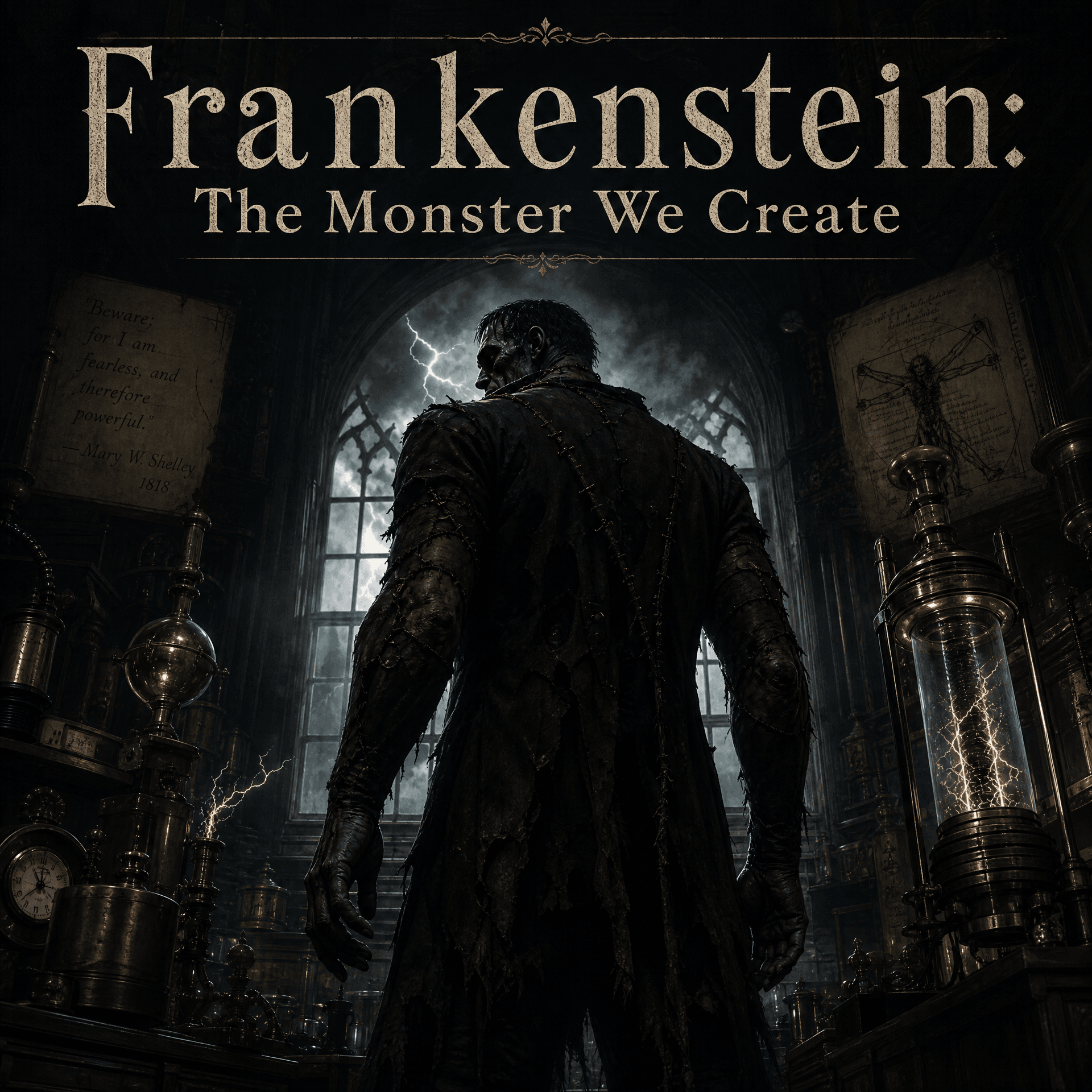
Frankenstein: The Monster We Create
The year was 1816, remembered in history as “The Year Without a Summer.” Across Europe, skies remained gray, storms rolled across the horizon, and an unusual darkness seemed to settle over the world. Crops failed. Temperatures dropped. Nature itself appeared disturbed.
Inside a villa near Lake Geneva, a group of young writers gathered to escape the relentless weather. They told ghost stories late into the night, discussing science, philosophy, and the mysteries of life itself. Among them was a teenager named Mary Shelley.
She lived during an age of extraordinary change. The Enlightenment had encouraged faith in reason and human progress. Scientific discoveries were expanding humanity’s understanding of the natural world. Experiments involving electricity fascinated the public. Some even wondered whether science might one day unlock the secret of life itself.
But Mary Shelley saw a question hidden beneath the excitement.
What happens when human ambition outruns human wisdom?
From that question emerged Frankenstein, a novel that would become one of the most influential works ever written. Though often remembered as a horror story, it is something far deeper—a tragic meditation on creation, responsibility, loneliness, and the consequences of playing god.
The story begins amid ice and isolation.
An explorer named Robert Walton sails toward the Arctic, driven by dreams of discovery. The frozen landscape around him seems endless, beautiful, and terrifying all at once. It is there, in one of the most remote places on Earth, that he encounters a broken man drifting through the wilderness.
That man is Victor Frankenstein.
Exhausted and haunted, Victor agrees to tell his story.
As his tale unfolds, the novel transports us back to his youth. Intelligent, ambitious, and endlessly curious, Victor grows fascinated by the mysteries of life. While others are content to accept the limits of human knowledge, he longs to push beyond them.
The boundary between life and death captivates him most of all.
Years of study consume him. He isolates himself from friends and family, sacrificing relationships in pursuit of a single goal. His obsession grows until it eclipses everything else.
Then, one stormy night, he succeeds.
Using knowledge gathered through science and relentless experimentation, Victor gives life to a creature assembled from lifeless parts.
For a moment, he achieves what no human has achieved before.
But triumph lasts only seconds.
The instant the creature opens its eyes, Victor is overwhelmed with horror.
The being before him is alive, yet its appearance fills him with terror. Its gigantic form, unnatural features, and haunting gaze shatter the dream he had imagined. Rather than accepting responsibility for what he has created, Victor flees.
And in that moment, the tragedy truly begins.
Abandoned by its creator, the creature enters a world that immediately rejects it.
Contrary to popular imagination, Shelley’s monster is not born evil. It begins life like a child—curious, sensitive, and eager to understand the world around it. It learns language. It observes human relationships. It experiences wonder, loneliness, and hope.
Yet everywhere it goes, people respond with fear.
They see only its appearance.
Doors close. Stones are thrown. Compassion disappears.
The creature longs for acceptance but encounters only rejection.
As the years pass, its loneliness transforms into bitterness. The desire for love slowly gives way to anger. Every act of cruelty deepens its despair.
What happens when a being is denied kindness at every turn?
What becomes of a soul that has never been shown compassion?
These questions form the emotional heart of the novel.
The relationship between Victor and his creation becomes a haunting mirror. Both are isolated. Both are consumed by obsession. Both become trapped by their choices.
Victor believes he is the victim of a monster.
The creature believes it is the victim of its creator.
And in many ways, both are right.
The genius of Frankenstein lies in its refusal to offer simple answers. There is no pure villain and no pure hero. Instead, Mary Shelley presents deeply flawed individuals whose actions create suffering that spreads outward like ripples across water.
Victor’s greatest failure is not creating life.
His greatest failure is abandoning the responsibility that comes with creation.
The creature’s greatest tragedy is not its appearance.
Its tragedy is the absence of love.
Throughout the novel, Shelley explores profound questions about human nature. Is evil something we are born with, or something we learn? Are people defined by their appearance or by their character? How much responsibility do creators bear for what they create?
These questions remain astonishingly relevant.
At its philosophical core, Frankenstein examines the dangers of unchecked ambition.
Victor Frankenstein represents humanity’s desire to conquer limits. He wants knowledge without restraint, achievement without consequence, power without accountability.
His story serves as a warning about what can happen when ambition becomes disconnected from morality.
Science itself is not condemned in the novel. Shelley admired knowledge and discovery. What she questions is the belief that achievement alone justifies action.
Just because something can be done, should it be done?
That question echoes through every chapter.
The novel also explores the universal human need for connection.
The creature suffers not because it is physically different but because it is emotionally abandoned. More than anything else, it longs to belong.
In this sense, the monster becomes one of literature’s most heartbreaking figures. Beneath its terrifying exterior exists a being desperate for friendship, understanding, and love.
Its transformation into a force of destruction is not sudden. It is gradual, shaped by loneliness and rejection.
Shelley invites readers to consider an uncomfortable possibility.
Perhaps monsters are not always born.
Perhaps they are created.
As the story moves toward its conclusion, the cycle of revenge intensifies. Creator and creation pursue one another across vast distances, each consumed by grief and anger.
What began as a scientific experiment has become a tragedy that destroys everyone it touches.
Victor loses family, friends, and peace of mind. The creature loses any remaining hope of happiness. Their conflict becomes a relentless pursuit through mountains, forests, and frozen wastelands.
The final scenes return to the Arctic, where the story began.
Victor dies still chasing the being he created.
The creature arrives too late to reconcile with its creator. Standing over Victor’s body, it expresses not triumph but sorrow.
This moment transforms everything.
The monster mourns.
The creature understands the devastation its actions have caused.
In the end, both creator and creation are victims of the same tragedy—a failure of compassion.
The novel closes not with victory but with loneliness. The creature disappears into the frozen darkness, carrying its grief into the unknown.
More than two centuries later, Frankenstein feels more relevant than ever.
Modern society possesses technologies Mary Shelley could scarcely have imagined. Artificial intelligence, genetic engineering, robotics, and scientific breakthroughs continually push the boundaries of possibility.
Yet her central question remains unchanged.
What responsibilities accompany creation?
The novel speaks not only to scientists but to parents, leaders, inventors, and anyone whose actions shape the lives of others. It reminds us that creation without responsibility can become destruction.
It also challenges us to examine our treatment of those who are different. The creature’s suffering begins because people judge its appearance before understanding its humanity.
That lesson remains painfully relevant in every generation.
In the end, Frankenstein is not a story about a monster stalking the night.
It is a story about loneliness seeking love, ambition seeking glory, and humanity confronting the consequences of its own actions.
Mary Shelley understood that the most frightening creations are not always those made in laboratories. Sometimes they emerge from neglect, prejudice, pride, and the refusal to accept responsibility.
And as the final pages close, one haunting question lingers in the silence: if we are responsible for the things we create, then what responsibilities do we bear for the people we help shape—and the monsters we leave behind?