The Secret Life of Books Hidden stories. Untold truths. Every book
“I will do everything. I will do the impossible.”: Meaning, Context, and Literary Significance
The line “I will do everything. I will do the impossible.” is a striking expression of determination associated with Fyodor Dostoevsky. Though simple in structure, it captures one of the central themes that runs through Dostoevsky’s works: the extraordinary power of human will in the face of suffering, limitation, and despair.
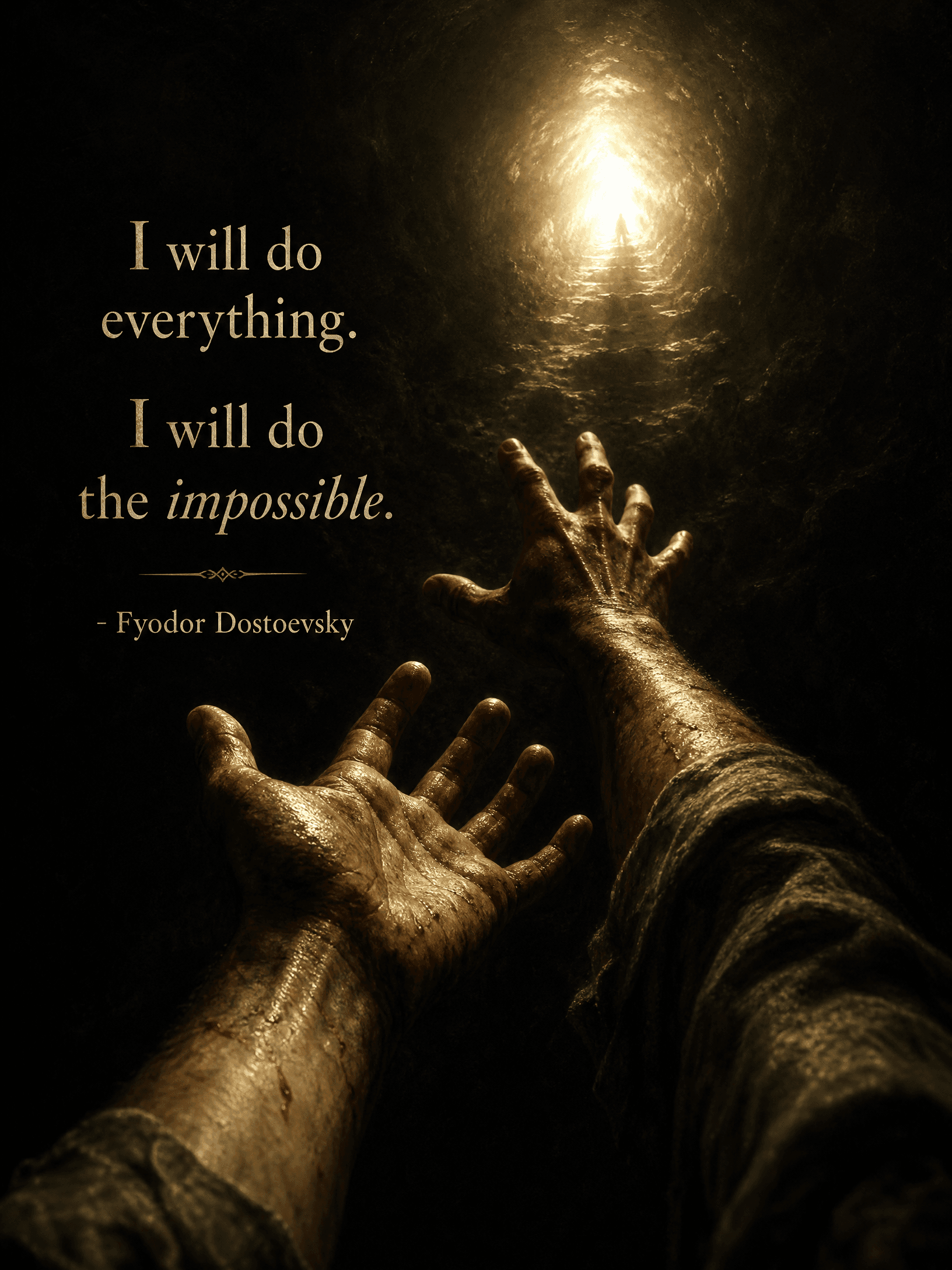
At its core, the statement is a declaration of resolve. The speaker refuses to accept boundaries imposed by circumstances, fear, or conventional expectations. The progression from “everything” to “the impossible” suggests a movement beyond ordinary effort toward an almost defiant belief in human potential.
In the context of Dostoevsky’s broader literary vision, such determination is rarely portrayed as mere optimism. His characters often struggle with poverty, guilt, loneliness, and spiritual crisis. Their greatest battles are not against the world alone, but against their own doubts and weaknesses. As a result, a declaration like this carries emotional weight—it emerges not from comfort, but from struggle.
The phrase “the impossible” is particularly significant. It represents goals that appear unattainable according to logic or circumstance. By insisting on pursuing them anyway, the speaker asserts the freedom of the human spirit to transcend apparent limitations.
Philosophically, the statement reflects Dostoevsky’s belief that human beings cannot be reduced to rational calculations. People often act against expectations, endure suffering for ideals, and pursue goals that seem unrealistic. This capacity for striving beyond reason is part of what makes them fully human.
The line also reflects the tension between reality and aspiration. The speaker may not actually achieve the impossible, but the willingness to attempt it becomes meaningful in itself. Courage is measured not only by success, but by the refusal to surrender.
Psychologically, the statement captures a mindset of resilience. In moments when obstacles appear overwhelming, the declaration functions as an act of self-assertion—a refusal to be defined by limitations.
At a deeper level, the quote speaks to hope. Not a passive hope that waits for change, but an active hope that commits itself to action despite uncertainty. The speaker chooses effort over resignation.
In the modern world, the line resonates because it reflects the universal desire to overcome barriers, whether personal, intellectual, emotional, or social. It appeals to the human instinct to keep striving even when success seems unlikely.
The power of the statement lies in its brevity and intensity. There are no explanations or qualifications—only determination. Its simplicity makes it memorable and inspiring.
In conclusion, “I will do everything. I will do the impossible.” is more than a declaration of ambition—it is a statement of human will. Through these words, Dostoevsky expresses the belief that true strength lies not in accepting limits unquestioningly, but in daring to challenge them, even when the odds seem impossible.