The Secret Life of Books Hidden stories. Untold truths. Every book
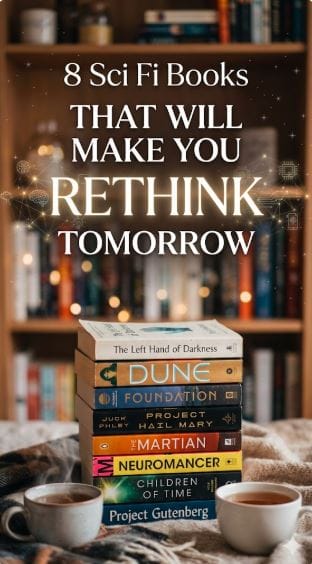
Eight Sci Fi Books That Will Make You Rethink Tomorrow
Some books imagine the future as a place filled with wonder and possibility. Others present it as a warning, showing what might happen if humanity continues on its current path without reflection. The most powerful science fiction does not only predict what lies ahead. It questions the present, challenges assumptions, and asks what it truly means to be human in a world shaped by technology, power, and change.
These books take readers beyond familiar realities and place them in worlds where society, identity, and survival are redefined. Yet despite their distant settings, they feel deeply relevant because they reflect the fears, hopes, and moral dilemmas of our own time. Reading them is not just an escape into imagination. It is an invitation to think more carefully about the future we are already creating.
1. Dune by Frank Herbert
Set on the desert planet Arrakis, this novel explores power, politics, religion, and survival in a harsh and unforgiving world. Through the journey of Paul Atreides, Herbert examines how leadership is shaped by environment, belief, and destiny. The story raises important questions about control over resources, the consequences of ambition, and the fragile balance between humanity and nature.
2. Project Hail Mary by Andy Weir
This story follows a lone astronaut on a mission to save Earth from extinction. As the narrative unfolds, science becomes a tool not just for survival but for connection and understanding. The novel highlights human curiosity, resilience, and the unexpected ways in which cooperation can emerge even in the most uncertain situations.
3. The Three Body Problem by Liu Cixin
This novel introduces a first contact scenario that is both intellectual and unsettling. It explores how humanity reacts to the possibility of a superior alien civilization. Liu examines science, philosophy, and the limits of human understanding, creating a story that challenges assumptions about progress and the future of our species.
4. Ender’s Game by Orson Scott Card
Through the story of a gifted child trained to become a military leader, this novel examines strategy, morality, and the cost of war. It questions how far society can go in the name of survival and whether intelligence alone can justify difficult decisions. The emotional weight of the story makes its futuristic setting feel deeply personal.
5. Neuromancer by William Gibson
Gibson’s novel envisions a world where technology and human consciousness are closely intertwined. It explores virtual reality, artificial intelligence, and the blurred line between physical and digital existence. The story captures both the excitement and the danger of a future where identity itself can be altered or lost.
6. Snow Crash by Neal Stephenson
This novel presents a fast moving world shaped by corporate control, digital spaces, and fragmented societies. Through its imaginative narrative, it explores language, technology, and culture in a future that feels chaotic yet strangely familiar. It reflects how communication and information shape human experience.
7. The Left Hand of Darkness by Ursula K. Le Guin
Le Guin’s novel takes place on a planet where gender is fluid, challenging traditional ideas of identity and relationships. Through the journey of an outsider trying to understand this society, the book explores trust, difference, and connection. It asks readers to reconsider assumptions about humanity by presenting a world built on entirely different norms.
8. Foundation by Isaac Asimov
Asimov’s classic series begins with the idea that history can be predicted through science. The story follows a group determined to preserve knowledge as a vast empire collapses. It explores cycles of rise and fall, the role of intellect, and the ways in which individuals influence the course of civilization.
Final Thoughts
These books do more than imagine what tomorrow might look like. They encourage readers to reflect on the choices being made today and the paths those choices create. Through distant planets, advanced technologies, and unfamiliar societies, they reveal truths about power, identity, and survival that feel immediate and urgent.
Reading them is not only about exploring the future. It is about understanding the present with greater clarity. They remind us that the world ahead is not fixed or inevitable. It is shaped by human decisions, values, and imagination. And in that sense, science fiction is not just about what could happen. It is about what we choose to become.