The Secret Life of Books Hidden stories. Untold truths. Every book
The Architect of the Modern Soul: Fyodor Dostoevsky
Fyodor Dostoevsky (1821–1881) is widely regarded as one of the greatest psychologists in world literature. A Russian novelist, short story writer, and philosopher, his work explores the darkest corners of the human psyche, the struggle between faith and reason, and the social political chaos of 19th-century Russia.
A Life of Extremes
Dostoevsky’s writing was forged in personal suffering. In 1849, he was arrested for participating in a radical intellectual group. He was led before a firing squad, only to receive a last-minute reprieve from the Tsar as the soldiers leveled their rifles. This “mock execution” changed him forever. He was instead sent to a Siberian labor camp for four years—an experience that shifted his focus from radical politics to deep spiritualism and a preoccupation with the “redemptive power of suffering.”
Themes and Philosophy
Dostoevsky’s work is characterized by several recurring “obsessions” that appear in your quotes:
The Duality of Man: He believed humans were capable of both sublime heights of love and terrifying depths of cruelty, often at the same time.
Existential Freedom: He argued that humans would rather have the freedom to choose wrongly than be forced to do “good” by logic or society (seen in his quote about “going wrong in one’s own way”).
The Search for Meaning: Amidst a rising tide of nihilism and atheism in Russia, Dostoevsky searched for a moral foundation, famously concluding through his characters that without a higher spiritual purpose, “everything is permitted.”
Major Works Represented
”Crime and Punishment”: A psychological thriller about a student who commits murder to test a theory of “superiority,” only to be destroyed by his own conscience.
”The Brothers Karamazov”: His final masterpiece, which serves as a massive philosophical debate on God, free will, and morality through the lens of a dysfunctional family.
”Notes from Underground”: Often called the first existentialist novel, it features a narrator who Rebels against logic, progress, and “the laws of nature.”
”White Nights”: A more lyrical, sentimental look at loneliness and the fleeting nature of happiness in the dream-like atmosphere of St. Petersburg.
10 Famous Quotes by Fyodor Dostoevsky
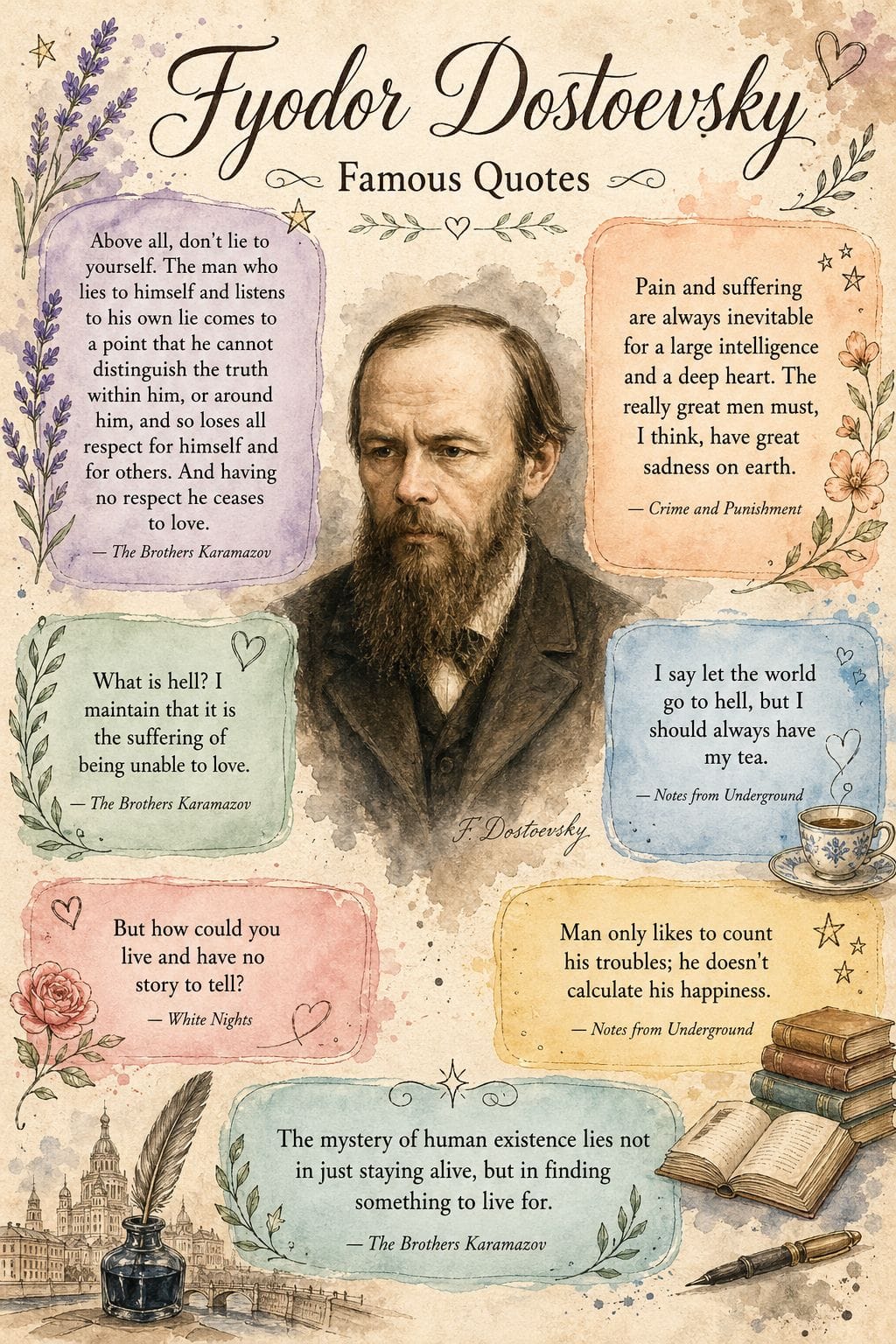
1. “Above all, don’t lie to yourself. The man who lies to himself and listens to his own lie comes to a point that he cannot distinguish the truth within him, or around him, and so loses all respect for himself and for others. And having no respect he ceases to love.” — *The Brothers Karamazov*
2. “Pain and suffering are always inevitable for a large intelligence and a deep heart. The really great men must, I think, have great sadness on earth.” — *Crime and Punishment*
3. “To go wrong in one’s own way is better than to go right in someone else’s.” — *Crime and Punishment*
4. “What is hell? I maintain that it is the suffering of being unable to love.” — *The Brothers Karamazov*
5. “I say let the world go to hell, but I should always have my tea.” — *Notes from Underground*
6. “But how could you live and have no story to tell?” — *White Nights*
7. “Man only likes to count his troubles; he doesn’t calculate his happiness.”** — *Notes from Underground*
8. “I love mankind,” he said, “but I find to my amazement that the more I love mankind as a whole, the less I love man in particular.”** — *The Brothers Karamazov*
9. “It takes something more than intelligence to act intelligently.”** — *Crime and Punishment*
10. “The mystery of human existence lies not in just staying alive, but in finding something to live for.”** — *The Brothers Karamazov*
To read Dostoevsky is to confront oneself. His quotes remain famous today because he spoke to the “universal man”—the part of all of us that is contradictory, seeking, and profoundly human.