The Secret Life of Books Hidden stories. Untold truths. Every book
Banned Book Spotlight: Winnie-the-Pooh by A. A. Milne
Why the Book Still Matters Today
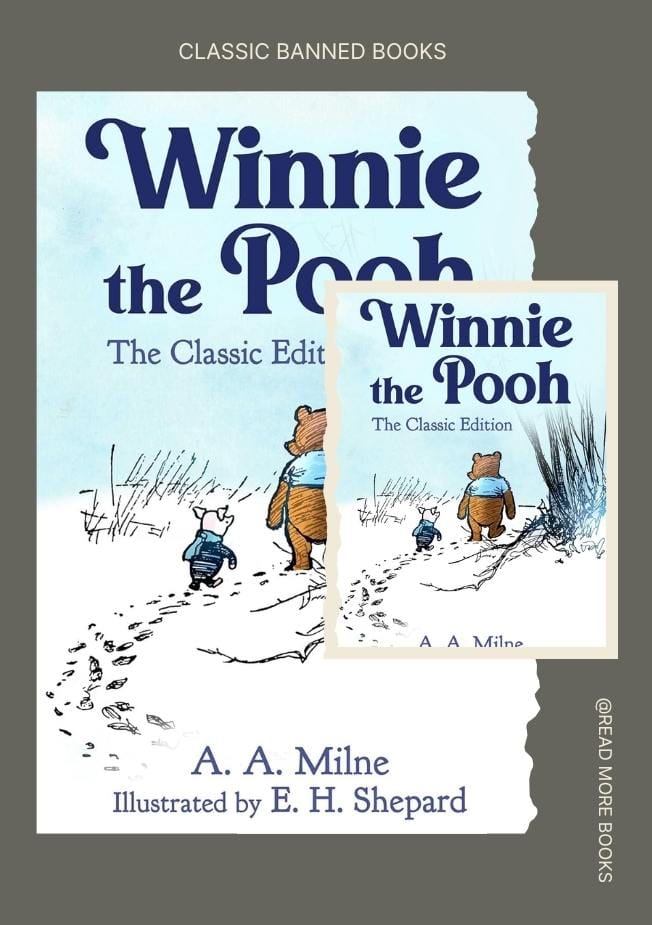
First published in 1926, Winnie-the-Pooh is a timeless children’s classic set in the peaceful world of the Hundred Acre Wood in the United Kingdom. On the surface, it is a simple story about a boy and his stuffed animals—but beneath that simplicity lies a gentle exploration of friendship, innocence, and emotional understanding.
Even today, in a fast-paced and often stressful world, the stories remind readers of something rare: the quiet value of slowing down, being kind, and simply being present.
✦ Content and Themes
Though written for children, the book carries subtle emotional depth:
Friendship and companionship – Pooh, Piglet, Eeyore, and others reflect different emotional temperaments.
Innocence and simplicity – Life in the Hundred Acre Wood values calm over chaos.
Emotional understanding – Each character represents feelings like worry, optimism, and sadness.
Imagination and play – Childhood creativity becomes a way of understanding the world.
Kindness in everyday life – Small gestures matter more than grand actions.
Its gentle storytelling has made it one of the most enduring works in children’s literature.
✦ About the Author: A. A. Milne
A. A. Milne was an English writer and playwright who created Winnie-the-Pooh inspired by his son’s toys and imagination. With illustrations by E. H. Shepard, the stories captured a nostalgic vision of childhood that continues to resonate across generations.
Milne’s work remains a cornerstone of early 20th-century children’s literature.
✦ Why Winnie-the-Pooh Was Banned or Challenged
Although widely beloved, the book has faced challenges in certain contexts due to:
Perceived political interpretations – In some regions, Winnie the Pooh imagery has been restricted due to political satire associations.
Concerns over emotional themes – Characters like Eeyore’s sadness have been interpreted as too melancholic for children.
Content suitability debates – Some critics questioned whether its slow, reflective tone suits modern educational expectations.
Most controversies arise not from the text itself, but from external interpretations.
✦ Final Thought
Winnie-the-Pooh was never just a children’s story—it is a gentle reminder of emotional honesty and the importance of simple joys. It teaches that even the quietest voices and smallest moments can carry deep meaning.
Reading it today is more than returning to childhood—it is an invitation to rediscover kindness, stillness, and the beauty of being “just as you are.”