The Secret Life of Books Hidden stories. Untold truths. Every book
Banned Book Spotlight: Alice’s Adventures in Wonderland by Lewis Carroll
Why the Book Still Matters Today
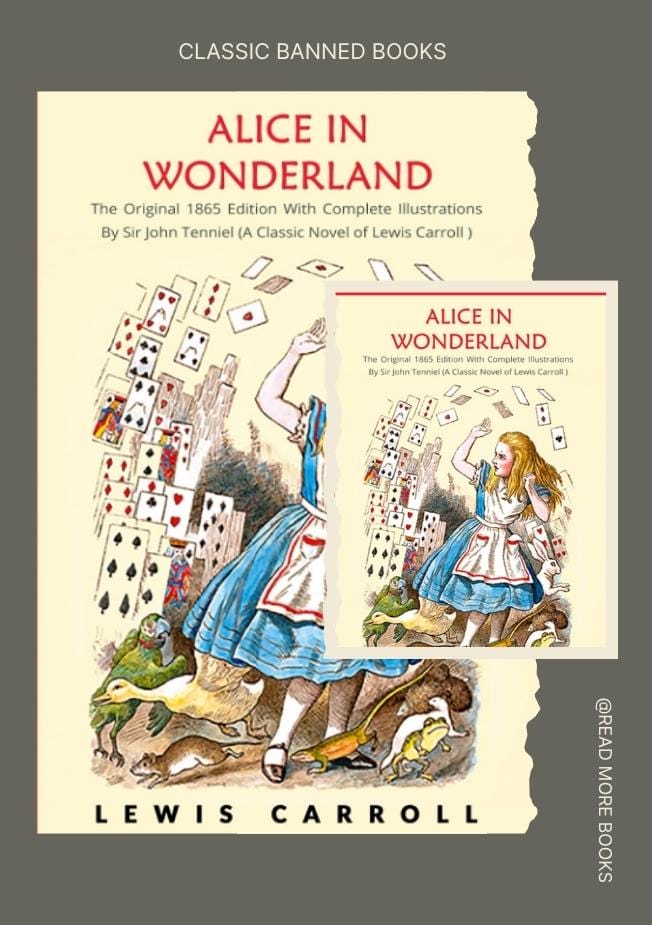
First published in 1865, Alice’s Adventures in Wonderland remains one of the most imaginative and influential works in children’s literature. It follows a curious girl who falls into a surreal world where logic bends, identity shifts, and nothing is quite as it seems.
Even today, in a world overwhelmed by rigid systems and expectations, the story continues to celebrate curiosity, imagination, and the freedom to question reality itself.
✦ Content and Themes
Beneath its playful fantasy lies deeper meaning and symbolism:
Curiosity and exploration – Alice’s journey begins with curiosity, reminding readers to question the world around them.
Absurdity of rules – The nonsensical laws of Wonderland reflect how authority can feel arbitrary.
Identity and transformation – Alice’s changing size symbolizes confusion during growth and self-discovery.
Language and meaning – Wordplay challenges how meaning is created and understood.
Logic vs. imagination – The story constantly blurs rational thinking and dreamlike wonder.
Its surreal nature makes it endlessly open to interpretation.
✦ About the Author: Lewis Carroll
Lewis Carroll was the pen name of Charles Lutwidge Dodgson, a mathematician, logician, and writer. His background in logic deeply influenced his storytelling, giving Alice’s Adventures in Wonderland its distinctive blend of nonsense, structure, and intellectual play.
His work continues to inspire literature, psychology, film, and art worldwide.
✦ Why Alice’s Adventures in Wonderland Was Banned or Challenged
Though widely loved, the book has faced challenges in certain contexts due to:
Nonsensical and “confusing” content – Some critics believed it distorted logic for children.
Perceived drug symbolism – Misinterpretations of hallucination-like imagery.
Talking animals and fantasy elements – Objections to unrealistic storytelling in education.
Subversive themes – The questioning of authority and rules was seen as problematic in some eras.
Many objections arise from interpretation rather than intent.
✦ Final Thought
Alice’s Adventures in Wonderland was never meant to teach obedience—it was meant to spark imagination. It invites readers into a world where questioning everything becomes the first step toward understanding oneself.
Reading it today is more than entering a fantasy—it is a reminder that curiosity is not confusion, but the beginning of discovery.