The Secret Life of Books Hidden stories. Untold truths. Every book
Crime and Punishment: The Weight of a Guilty Soul
In the middle of the nineteenth century, Russia stood between two worlds. Ancient traditions still lingered in its streets, churches, and villages, while new ideas rushed in from Europe like a rising tide. Poverty and wealth existed side by side. Grand palaces overlooked neighborhoods where hunger was a daily companion. Intellectuals debated the future of humanity, questioning religion, morality, and the meaning of justice itself.
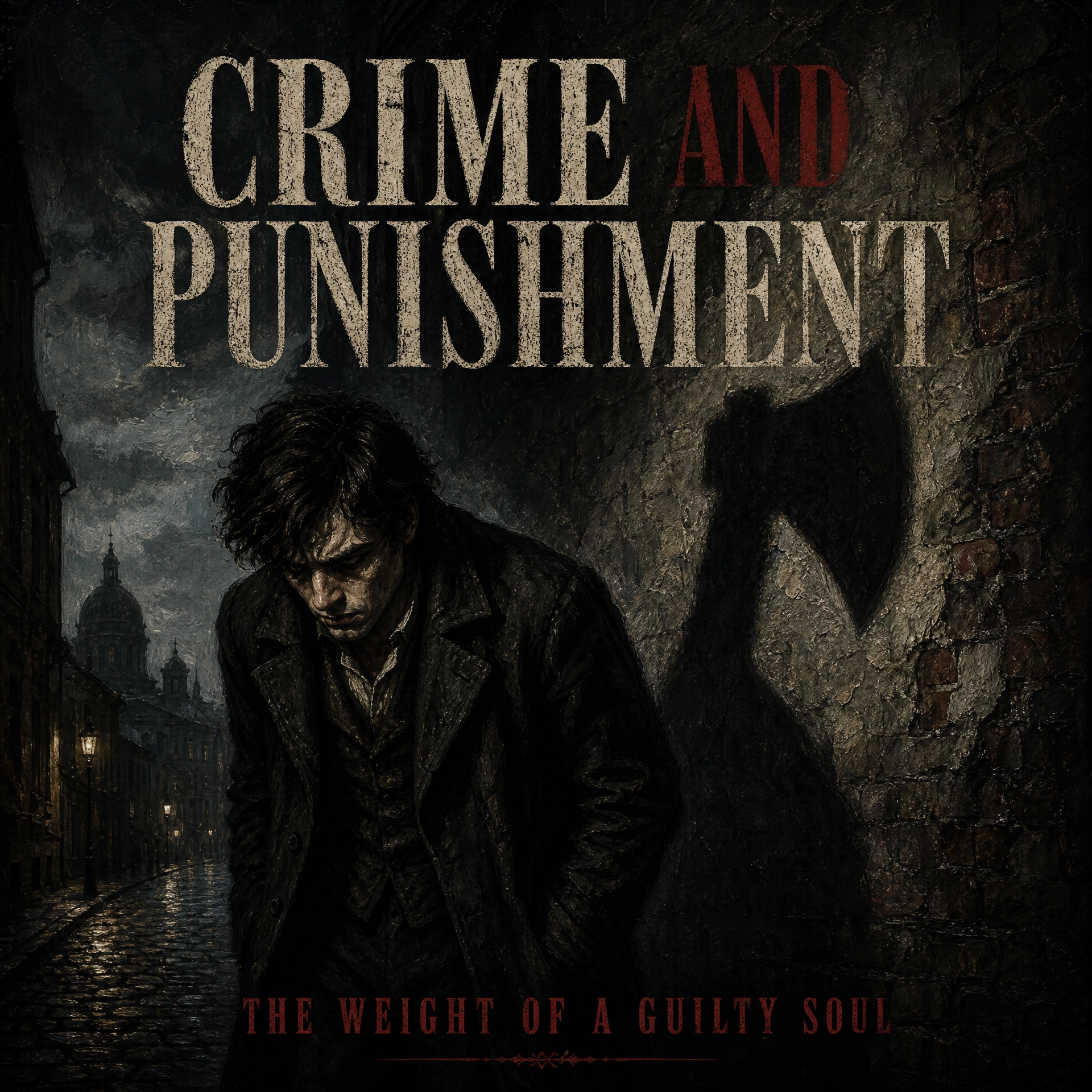
It was an age of uncertainty, and few people felt that uncertainty more deeply than Fyodor Dostoevsky. He was not merely a novelist observing society from a distance. He had lived through hardship, imprisonment, political persecution, and spiritual crisis. He knew what it meant to stand at the edge of despair and ask whether redemption was still possible.
Out of those experiences emerged Crime and Punishment, a novel that would become one of the most profound explorations of guilt, morality, and the human conscience ever written.
The story unfolds in the crowded, suffocating streets of Saint Petersburg, a city that feels less like a setting and more like a living presence. The air is heavy. The buildings seem to press inward. Poverty hangs over everything like a storm cloud that never quite breaks.
Among these streets wanders Rodion Romanovich Raskolnikov, a former student trapped between pride and desperation. He lives in a tiny rented room that resembles a coffin more than a home. Hunger gnaws at him. Debt follows him. Yet beneath his poverty lies something even more dangerous—a restless intellect convinced that ordinary rules may not apply to extraordinary people.
Raskolnikov has become obsessed with an idea.
Throughout history, he reasons, great men have often broken laws. Conquerors, rulers, and revolutionaries have caused suffering in pursuit of what they believed to be a greater good. If such figures are celebrated rather than condemned, then perhaps morality itself is not absolute. Perhaps certain individuals possess the right to step beyond conventional ethics.
The theory fascinates him. But theories are easy when they remain on paper.
The true test arrives when he begins to contemplate the murder of an old pawnbroker. She is greedy, cruel, and widely disliked. To Raskolnikov, she appears almost symbolic—a useless life standing in the way of greater possibilities. If her money could be used to help others, would her death truly be a crime?
The question grows inside him until it becomes impossible to ignore.
Then one sweltering evening, he acts.
The murder itself unfolds with terrifying intensity. It is not glorious. It is not heroic. It is clumsy, chaotic, and horrifying. Fear replaces certainty. Blood replaces theory.
In a single moment, an intellectual argument becomes reality.
Yet the true story begins after the crime.
Raskolnikov expects liberation. Instead, he discovers imprisonment of a different kind.
The walls of his room seem to close around him. Every conversation feels dangerous. Every knock at the door sends panic through his body. His thoughts become tangled in suspicion, fear, and self-loathing. He drifts through the city like a ghost, carrying a burden no one can see but everyone seems somehow to sense.
The brilliance of Dostoevsky’s novel lies in this transformation. The murder is not the climax; it is the beginning of a deeper psychological journey. The real battlefield exists within Raskolnikov himself.
He wants to believe he is extraordinary. He wants to believe he has transcended ordinary morality. Yet his conscience refuses to cooperate.
No prison cell confines him, but guilt follows him everywhere.
Around him moves a cast of unforgettable characters, each reflecting different aspects of humanity.
There is Sonia Marmeladova, a young woman forced into heartbreaking sacrifices to support her family. Despite suffering, humiliation, and poverty, she preserves a remarkable capacity for compassion. Where Raskolnikov embraces intellectual pride, Sonia embodies humility and faith.
Their relationship forms the emotional heart of the novel.
Sonia sees through Raskolnikov’s defenses. She recognizes his suffering even before she knows its cause. In a world filled with judgment and cruelty, she offers understanding. Her kindness becomes a light shining into the darkest corners of his soul.
Then there is Porfiry Petrovich, the investigating magistrate whose methods are as psychological as they are legal. Rather than relying solely on evidence, he patiently studies human nature. He understands that guilt often reveals itself long before a confession.
The exchanges between Porfiry and Raskolnikov feel less like detective scenes and more like philosophical duels. Each conversation tightens the tension, bringing the truth closer to the surface.
Yet the greatest conflict remains internal.
Raskolnikov is divided against himself. One part clings desperately to his theory. Another part longs for forgiveness. He seeks superiority yet craves connection. He wants freedom but discovers that isolation is its own form of punishment.
Is a person defined by their actions or by their intentions? Can intelligence justify cruelty? Does suffering possess the power to transform?
These questions pulse through every chapter.
At its philosophical core, Crime and Punishment explores the relationship between morality and human identity. Raskolnikov believes that reason alone can determine right and wrong. He attempts to construct a worldview in which compassion becomes secondary to logic.
But Dostoevsky challenges that vision relentlessly.
The novel suggests that human beings are not purely rational creatures. We possess emotions, conscience, empathy, and spiritual needs that cannot simply be ignored. A theory may convince the mind, but it cannot silence the heart.
The conflict between pride and humility emerges as one of the story’s central themes. Raskolnikov’s suffering begins not merely because he commits murder but because he elevates himself above others. He attempts to place himself beyond ordinary humanity.
The tragedy is that he discovers no one can truly escape their own humanity.
The novel also wrestles with justice itself. Legal punishment matters, but Dostoevsky is interested in something deeper. Long before any official sentence arrives, Raskolnikov is already being punished. His conscience becomes judge, jury, and executioner.
The title itself reveals this truth. Crime and punishment are not separate events. They are connected. The punishment begins the moment the crime is committed.
As the story moves toward its conclusion, resistance becomes impossible. The weight of guilt grows too heavy to carry. The walls built around the truth begin to crumble.
When Raskolnikov finally confesses, the moment feels less like defeat and more like surrender to reality. For the first time, he stops running from himself.
His sentence sends him far from Saint Petersburg, but physical exile is only part of the journey. The deeper transformation occurs within his spirit.
The ending is not traditionally triumphant. Dostoevsky offers no easy redemption. Instead, he presents something more realistic and more profound—the possibility of renewal.
Through suffering, Raskolnikov begins to rediscover his connection to humanity. Through Sonia’s unwavering compassion, he glimpses the possibility of forgiveness. The novel closes not with certainty but with hope.
More than a century later, Crime and Punishment remains startlingly relevant.
Modern society still wrestles with many of the same questions. People continue to justify harmful actions in pursuit of success, ideology, or personal ambition. Public image often masks private struggles. Many individuals carry invisible burdens of regret, guilt, and moral conflict.
The technology has changed. The cities have changed. But the human heart remains remarkably familiar.
Raskolnikov’s story resonates because it reflects something universal. Most people will never commit a crime like his, yet many understand what it means to live with a mistake, to wrestle with conscience, or to search for redemption after failure.
That is why the novel endures. It speaks not only about murder but about the human condition itself.
In the end, Crime and Punishment is not merely the story of a crime. It is the story of a soul struggling to find its way back to itself. Dostoevsky understood that the greatest prisons are often invisible and that freedom cannot be achieved through power, intellect, or rebellion alone.
As the final pages fade, one question lingers long after the story ends: if guilt is the shadow cast by our actions, is redemption something we earn—or something we learn to accept?