The Secret Life of Books Hidden stories. Untold truths. Every book
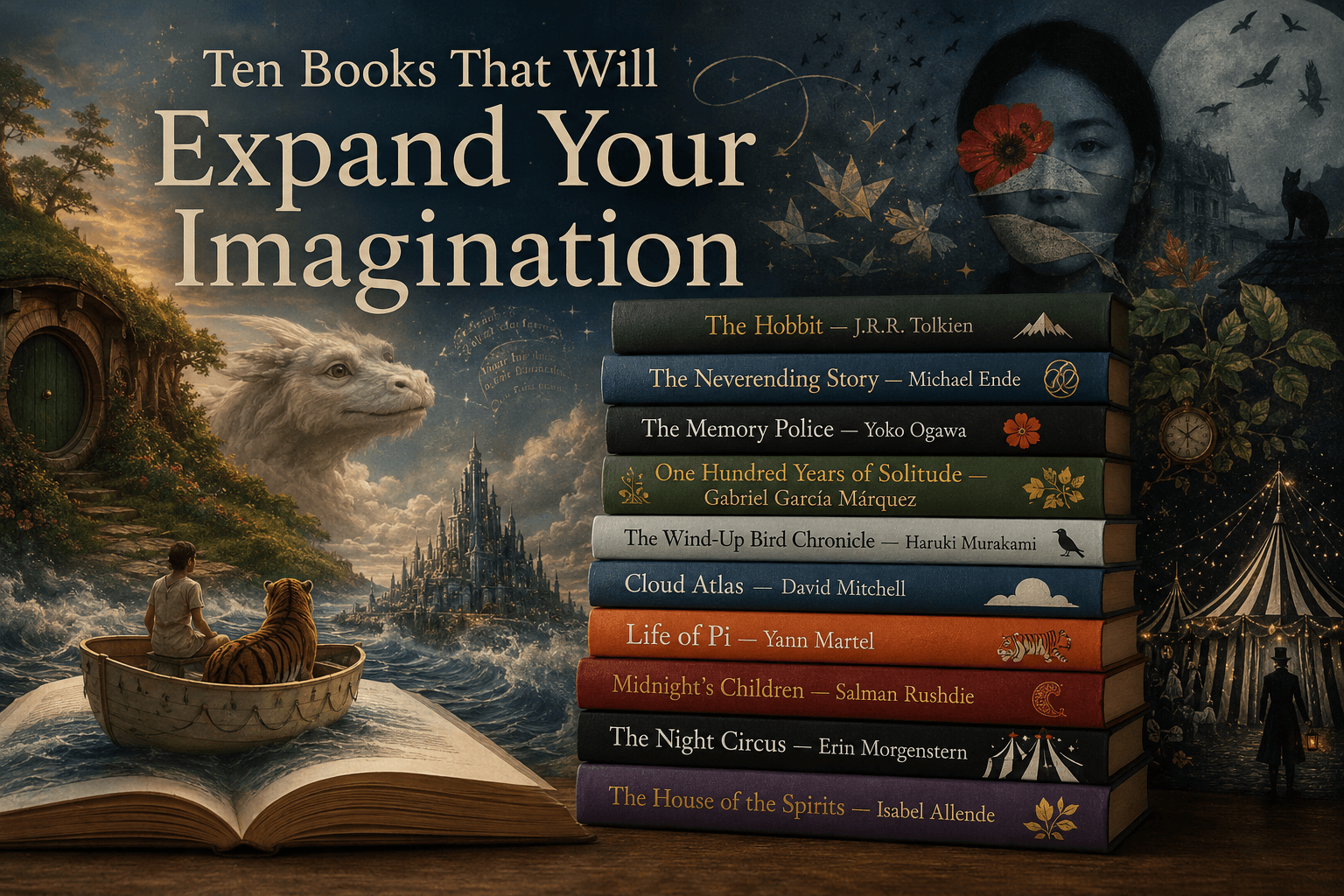
Ten Books That Will Expand Your Imagination
Some books entertain you for a few hours. Others change the way you see reality itself. The novels on this list do more than tell stories — they stretch the imagination, challenge ordinary thinking, and invite readers into worlds where memory, time, magic, identity, and human possibility feel endlessly alive. From surreal dreamscapes to epic fantasy adventures, these books remind us that imagination is one of humanity’s greatest powers.
1. The Hobbit — J.R.R. Tolkien
Before fantasy became a global phenomenon, The Hobbit opened the door to an unforgettable world of dragons, hidden kingdoms, ancient maps, and unlikely heroes. The story follows Bilbo Baggins, an ordinary hobbit who leaves the safety of his home for an unexpected adventure with dwarves and the wizard Gandalf.
What makes the novel so imaginative is Tolkien’s ability to create an entire mythology that feels ancient and real. Every mountain, creature, and language seems to have its own history. Readers are transported into a world where courage grows slowly, friendship matters deeply, and even the smallest person can change the course of history. The book inspires imagination by making readers feel that adventure might exist just beyond the borders of ordinary life.
2. The Neverending Story — Michael Ende
This is more than a fantasy novel — it is a story about the power of stories themselves. A lonely boy named Bastian discovers a mysterious book and becomes drawn into the magical land of Fantastica, where imagination is literally disappearing.
Michael Ende blurs the boundary between reader and character in brilliant ways. As Bastian reads, the reader feels pulled into the adventure alongside him. The novel explores creativity, fear, identity, and the importance of imagination in a world that often becomes cynical and empty. It encourages readers to believe that fantasy is not an escape from reality but a way of understanding it more deeply.
3. The Memory Police — Yoko Ogawa
Quiet, haunting, and deeply original, The Memory Police takes place on an island where objects mysteriously disappear from existence — and soon afterward, people forget they ever existed at all. Birds vanish. Roses disappear. Photographs become meaningless. Only a few individuals still remember, and they are hunted by the authorities.
Yoko Ogawa creates an atmosphere that feels dreamlike and unsettling. The novel expands the imagination by asking disturbing philosophical questions: What happens when memories disappear? Can identity survive without the things we remember? The story transforms ordinary objects into symbols of human existence, making readers think about memory, loss, and the fragility of reality itself.
4. One Hundred Years of Solitude — Gabriel García Márquez
Widely considered one of the greatest novels ever written, One Hundred Years of Solitude tells the story of the Buendía family across generations in the mythical town of Macondo. Here, ghosts walk among the living, insomnia spreads like a plague, and impossible events are treated as completely normal.
Gabriel García Márquez’s masterpiece introduces readers to magical realism at its finest. The novel expands the imagination because it refuses to separate fantasy from reality. Dreams, myths, history, politics, and everyday life merge into one unforgettable experience. Readers come away feeling that the world is far stranger, richer, and more mysterious than they once believed.
5. The Wind-Up Bird Chronicle — Haruki Murakami
Haruki Murakami’s fiction often feels like stepping into a dream where logic no longer fully applies. The Wind-Up Bird Chronicle begins with a simple search for a missing cat but slowly transforms into a surreal journey involving abandoned wells, parallel realities, strange encounters, and hidden psychological truths.
Murakami expands the imagination through atmosphere rather than spectacle. His stories feel deeply emotional yet mysterious, encouraging readers to accept uncertainty instead of demanding explanations. The novel explores loneliness, memory, violence, and identity while constantly shifting between reality and the subconscious mind. Reading it feels like wandering through a maze where every corridor reveals another hidden layer of existence.
6. Cloud Atlas — David Mitchell
Few novels are as structurally ambitious as Cloud Atlas. The book contains interconnected stories spanning centuries — from the 19th century to a distant post-apocalyptic future. Each narrative has a different style, voice, and genre, yet all are mysteriously linked.
David Mitchell demonstrates how imagination can reshape storytelling itself. The novel challenges readers to think about time, reincarnation, power, freedom, and the ways human actions echo across generations. Every story becomes part of a much larger pattern, creating a reading experience that feels intellectually thrilling and emotionally profound.
7. Life of Pi — Yann Martel
At first glance, Life of Pi seems like a survival story about a boy stranded on a lifeboat with a Bengal tiger. But the novel slowly evolves into something much deeper — a meditation on faith, storytelling, truth, and the human need to believe in meaning.
Yann Martel fills the novel with vivid imagery and philosophical wonder. The ocean becomes a place of mystery and transformation. Readers are constantly forced to question what is real and what stories people create to survive emotionally. By the end, the novel asks one unforgettable question: which version of reality do we choose to believe?
8. Midnight’s Children — Salman Rushdie
Born at the exact moment India gains independence, Saleem Sinai discovers he shares a telepathic connection with hundreds of other children born in that same historic hour. Each child possesses extraordinary abilities, and together they represent the future of a new nation.
Salman Rushdie combines history, politics, fantasy, mythology, and satire into a dazzling narrative filled with energy and invention. The novel expands the imagination by transforming historical events into something mythic and magical. It reminds readers that nations, like individuals, are shaped by stories, memories, and dreams.
9. The Night Circus — Erin Morgenstern
A mysterious circus arrives without warning and opens only at night. Inside are impossible wonders: clouds floating indoors, magical gardens made of ice, and tents that seem to contain entire universes. At the center of it all is a dangerous magical competition between two young illusionists.
Erin Morgenstern creates one of the most visually imaginative novels of modern fantasy. The atmosphere feels enchanting and cinematic, making readers feel as though they are wandering through the circus themselves. More than anything, the novel celebrates creativity, beauty, and the emotional power of wonder.
10. The House of the Spirits — Isabel Allende
Blending family saga, political history, and supernatural elements, The House of the Spirits follows several generations of the Trueba family in an unnamed Latin American country. Spirits communicate with the living, emotions shape destiny, and personal stories intertwine with national upheaval.
Isabel Allende fills the novel with passion, memory, tragedy, and magical beauty. The story expands the imagination by showing how the mystical and the ordinary can exist side by side. Love, power, revenge, and resilience become larger-than-life forces that shape both individuals and history itself.
Final Thoughts
The best imaginative books do more than create fictional worlds — they transform the reader’s inner world. These novels challenge assumptions, stretch creativity, and reveal possibilities hidden beneath ordinary life. Some transport us to magical lands, while others reshape reality itself through memory, dreams, or myth. Together, they prove that imagination is not merely entertainment; it is a way of seeing deeper into what it means to be human.
Whether you enjoy fantasy, magical realism, philosophical fiction, or surreal storytelling, these books offer journeys that stay with readers long after the final page.