The Secret Life of Books Hidden stories. Untold truths. Every book
“We Are All in the Gutter, but Some of Us Are Looking at the Stars” Meaning, Context, and Literary Significance
Few literary quotes capture the tension between human suffering and human hope as beautifully as the line:
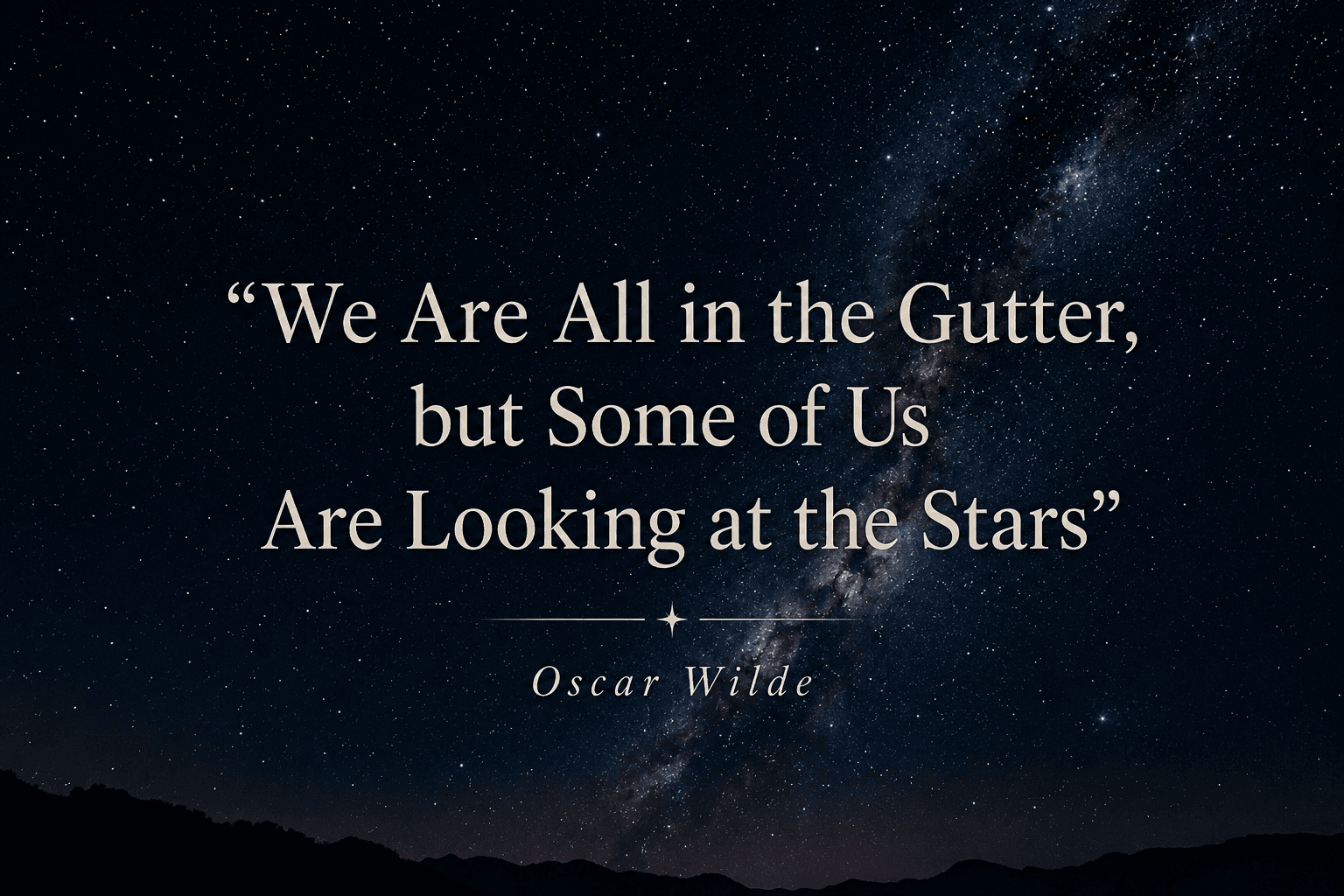
“We are all in the gutter, but some of us are looking at the stars.”
This famous quote comes from the play Lady Windermere’s Fan by Oscar Wilde, first performed in 1892. Over a century later, the line continues to resonate because it speaks to something universal: life is imperfect, painful, and often disappointing, yet people still dream, imagine, and search for beauty beyond their circumstances.
The quote has become one of Wilde’s most enduring reflections on hope, ambition, and the human condition.
Origin of the Quote
The line appears in Lady Windermere’s Fan, a satirical comedy of manners that explores hypocrisy, morality, reputation, and social expectations in Victorian society.
The full exchange is spoken by Lord Darlington, one of the play’s most memorable characters:
“We are all in the gutter, but some of us are looking at the stars.”
Although the play is filled with wit and clever dialogue, this line stands apart because of its emotional depth and philosophical meaning.
Meaning of the Quote
At its core, the quote contrasts two realities:
- The “gutter” symbolizes human weakness, suffering, imperfection, and the harsh realities of life.
- The “stars” symbolize hope, dreams, beauty, imagination, and higher ideals.
Wilde suggests that all human beings share difficult conditions. No one escapes pain, failure, loneliness, or moral imperfection. Everyone, in some sense, lives in the “gutter.”
Yet the difference lies in perspective.
Some people become consumed by bitterness and despair. Others continue to look upward—to beauty, meaning, art, love, or possibility.
The quote is ultimately about hope in the middle of hardship.
The Symbolism of the Gutter and the Stars
The Gutter
The gutter represents:
- Human flaws
- Social corruption
- Poverty or suffering
- Emotional struggles
- Moral imperfection
Wilde rejects the idea that human life is purely noble or pure. Instead, he acknowledges the messy reality of existence.
The Stars
The stars symbolize:
- Dreams
- Imagination
- Beauty
- Aspiration
- Spiritual or emotional transcendence
Even when life feels dark, people still possess the ability to imagine something greater.
This contrast between darkness and light gives the quote its lasting emotional power.
Historical and Cultural Context
Oscar Wilde wrote during the Victorian era, a period marked by rigid social rules, moral judgment, and obsession with public reputation.
Victorian society often demanded outward perfection while hiding inner hypocrisy. Wilde frequently criticized this contradiction in his works.
In Lady Windermere’s Fan, characters struggle with appearances, scandal, and hidden truths. Wilde uses humor and satire to expose the gap between society’s moral ideals and actual human behavior.
The quote reflects Wilde’s belief that human beings are imperfect but still capable of beauty and imagination.
It also reflects Wilde’s own life. Despite his brilliance and fame, Wilde later experienced public humiliation, imprisonment, and personal suffering. His writings often reveal both cynicism about society and faith in beauty and art.
Literary Significance
This line remains one of the most quoted passages in English literature because it captures a profound truth in a single sentence.
1. It Balances Realism and Hope
Wilde does not deny suffering. He acknowledges it directly.
But instead of ending in despair, the quote offers a vision of resilience and aspiration.
This balance makes the line emotionally honest and inspiring at the same time.
2. It Reflects Wilde’s Philosophy of Beauty
Wilde believed art and beauty were essential parts of human life.
Even in painful circumstances, people still seek meaning through:
- art,
- imagination,
- love,
- and idealism.
The “stars” represent this human desire to rise above ordinary existence.
3. It Speaks to Universal Human Experience
The quote remains timeless because every generation relates to it differently.
For some, the gutter represents:
- poverty,
- heartbreak,
- anxiety,
- failure,
- or social injustice.
The stars may represent:
- hope,
- ambition,
- creativity,
- freedom,
- or emotional healing.
Its universality allows readers to find personal meaning within it.
Modern Relevance
Today, the quote continues to appear in:
- literature discussions,
- motivational speeches,
- films,
- social media,
- and everyday conversations.
In an age shaped by uncertainty, stress, and social pressure, Wilde’s words still remind people that perspective matters.
The quote suggests that difficult circumstances do not completely define a person. Human beings still possess the ability to dream, imagine, and seek beauty beyond immediate suffering.
That idea continues to resonate deeply in modern culture.
Why the Quote Endures
The enduring appeal of this line comes from its emotional honesty.
It does not offer naïve optimism. Wilde never claims life is easy or fair.
Instead, he suggests something more powerful:
that hope itself is an act of resistance.
To “look at the stars” is to refuse complete surrender to despair.
That is why the quote continues to inspire readers more than a century after it was written.
Final Thoughts
“We are all in the gutter, but some of us are looking at the stars” remains one of Oscar Wilde’s most profound observations about human life.
The quote recognizes suffering without losing sight of beauty. It reminds readers that although imperfection is universal, so is the capacity for hope, imagination, and aspiration.
In just one sentence, Wilde captures the struggle between despair and wonder that defines much of the human experience.
And perhaps that is why the line still feels timeless today.